Etsy Listing Renewal Strategy: When It Helps, When It Wastes Money
An Etsy listing renewal strategy that actually works: when renewal moves the needle and when to spend that time fixing the listing instead.
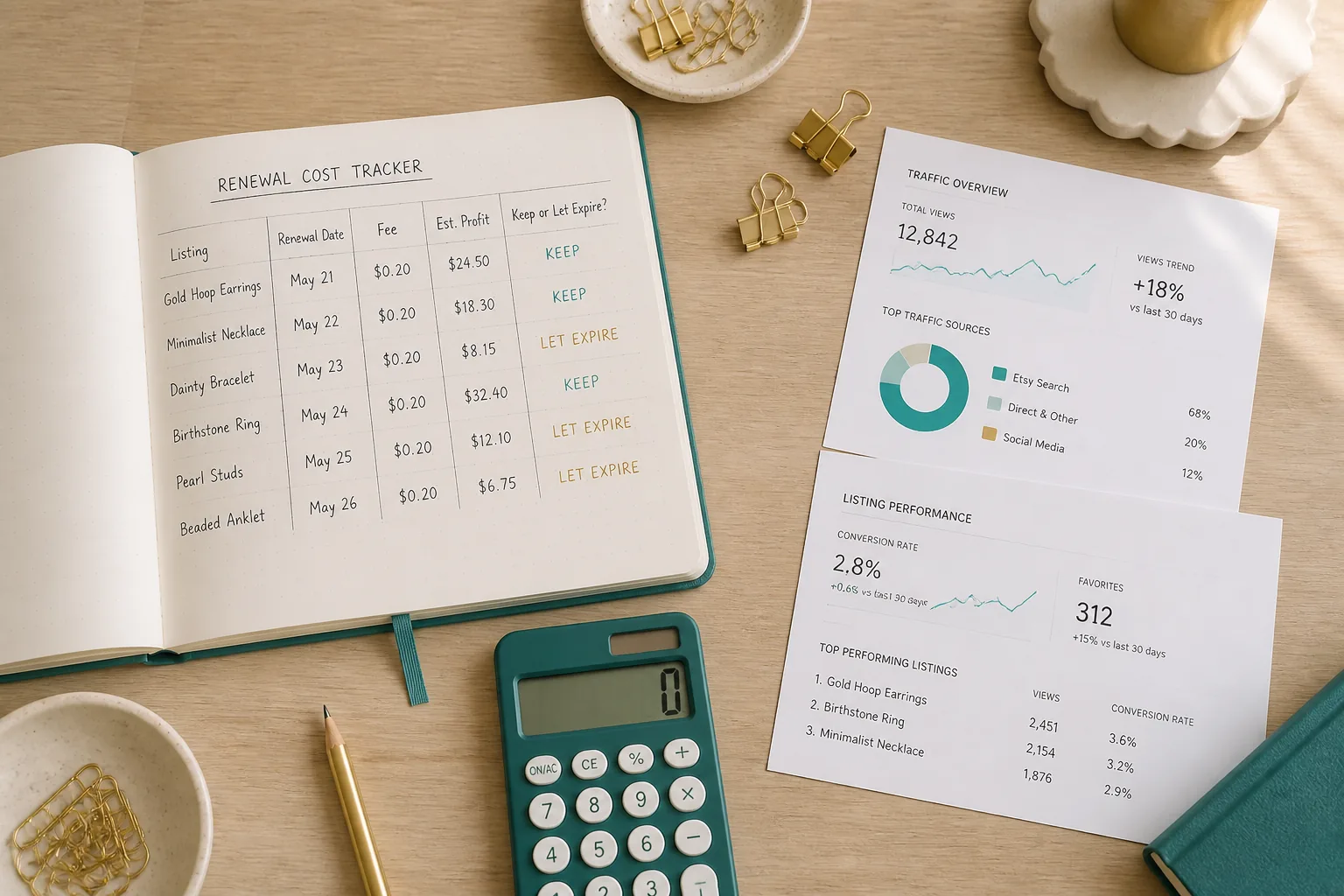
How Etsy’s Renewal Mechanism Actually Works
Every Etsy listing has a 4-month lifespan from its activation date. When that period ends, the listing either expires (if auto-renew is off) or renews automatically for another $0.20 fee. What most sellers overlook is that renewal is primarily a billing event, not a search ranking reset.
Etsy’s search algorithm ranks listings based on a combination of factors: relevancy to the search query, listing quality score (click-through rate, add-to-cart rate, conversion rate), recency, and seller account health. Renewal touches one of these: recency.
When a listing renews, Etsy treats it as “recently active,” which gives it a small boost in freshness-weighted search queries. This effect is real but time-limited. In practice, most sellers observe improved placement for 24–72 hours before the listing settles back to its baseline position. The algorithm quickly reassesses based on actual engagement data, which overwrites the freshness signal.
The takeaway: renewal is a mild lever, not a solution. It works within a healthy listing (one with a strong CTR and conversion history) and does almost nothing for a listing the algorithm has already assessed as underperforming.
When Renewal Actually Helps
New Listing Cold Start
Fresh listings haven’t accumulated click or conversion data yet. During this window, recency carries more weight in search because the algorithm has nothing else to go on. Manually renewing a new listing after its first 30 days (rather than letting 4 months elapse) keeps the freshness signal active while you’re building early traction. This isn’t necessary for every listing, but it makes sense for products where you’re actively promoting through social or ads.
Seasonal Timing Windows
Seasonal search traffic follows predictable spikes. Valentine’s Day queries peak around February 7–12. Christmas peaks November 25 – December 15. Halloween builds from early October. Back-to-school surges in late July.
For listings targeting these windows, a manual renewal 2–3 weeks before the spike puts the freshness signal in play when buyer volume is highest. A $0.20 renewal fee that aligns your listing with peak search traffic is a reasonable spend. A renewal in mid-February for a Valentine’s Day listing is not.
Low-Inventory Signal Management
If you sell physical items alongside digital downloads, low stock triggers a visibility modifier in some search contexts (“Only 2 left!”). For digital products, this doesn’t apply; digital inventory doesn’t deplete. But if you’re managing physical variant listings alongside digital ones, renewal timing can interact with Etsy’s urgency signals. This is niche, but worth knowing.
When Renewal Wastes Your Money
Listings With Bad CTR
If buyers are seeing your listing in search and not clicking, renewal won’t change that. The problem is the thumbnail or the title, the two elements visible in search results. Renewing pushes the listing back into rotation with the same image and the same title that wasn’t generating clicks. You’ll spend $0.20 and get the same result faster.
The diagnostic: check your Etsy Stats for each listing’s impressions vs. clicks. If you’re getting 1,000+ impressions and fewer than 20 clicks over 30 days, that’s a CTR problem. Fix the thumbnail first, then the title.
Listings With Conversion Problems
High CTR but low conversion means buyers are clicking and leaving. Renewal has zero effect on what happens after the click. The problem lives in the listing itself: the description is unclear, the price is misaligned with the perceived value, the images don’t answer buyer questions, or the product simply isn’t what the search query implied.
Run a renewal on a listing like this and you’re paying to send more traffic to a page that isn’t converting. Address the conversion issue first.
Listings With Ranking Problems
If a listing is buried on page 8 of search results, a $0.20 renewal will temporarily move it to, say, page 6. It will return to page 8 within days. The ranking problem is structural: weak tags, a title that doesn’t match buyer intent, or a quality score that Etsy’s algorithm has penalised over time.
These problems require changes to the listing itself, not a billing event.
Manual vs. Auto-Renew: A Decision Framework
Turn auto-renew ON for:
- Evergreen listings with proven sales history (at least 3 sales in the past 6 months)
- Products in consistently searched categories (wall art, planners, SVG files)
- Your top 20% of listings by revenue
Turn auto-renew OFF for:
- Listings with zero sales in 90+ days
- Seasonal products outside their relevant window (a Christmas listing in March)
- Listings you know need reworking (don’t keep paying $0.20 every 4 months on a listing you haven’t fixed)
Manual renewal is appropriate for:
- Seasonal listings 2–3 weeks before their peak window
- New listings in their first 60 days where you want freshness maintained
- Testing a newly revised listing after you’ve updated the title and tags
Cost Analysis Per Listing
At $0.20 per renewal per 4 months, the annual renewal cost per listing is $0.60. That sounds trivial, but:
- 50 listings on auto-renew = $30/year in renewal fees
- 200 listings on auto-renew = $120/year
- 500 listings on auto-renew = $300/year
More importantly, the opportunity cost matters. If you’re spending time monitoring renewals and manually renewing underperforming listings, that time would generate more value spent improving the listings themselves.
Better Alternatives to Renewal
Before reaching for the renew button, run through these checks:
Thumbnail audit. Is the main image sharp, well-lit, and immediately clear about what the product is? For digital products (wall art prints, clipart bundles, SVG files), the thumbnail is the primary sales tool. A weak thumbnail costs you clicks that no renewal can recover.
Title revision. Etsy’s algorithm indexes the first 40 characters of your title most heavily. If your primary keyword isn’t in the first 5 words, move it there. Check whether your title matches actual search phrasing. Etsy’s search bar autocomplete shows you what buyers type.
Tag replacement. You have 13 tags. Each one should be a phrase buyers search, not a single word. “Botanical wall art print” outperforms “botanical” as a tag. If you haven’t touched your tags in 6 months, audit them against current search trends.
Description update. The first 160 characters of your description appear as the preview in some Etsy contexts. Lead with the most buyer-relevant information (what they get, the format, the size), not a creative opener.
Tools like Elistit’s SEO listing copy generator produce title, 13-tag, and description combinations calibrated to buyer search intent, which addresses the actual ranking levers rather than the renewal lever.
The Renewal-vs-Relist Question
Relisting means deactivating a listing and creating a new one, not the same as renewal. A new listing gets full freshness credit and no historical quality score (which can be good or bad).
Relist when:
- The listing has zero sales, zero reviews, and has been live for 60+ days
- You’re making substantial changes to the title, thumbnail, and product positioning (essentially launching a different product)
- The listing’s quality score is likely penalised from an early period of poor performance
Renew when:
- The listing has sales history you want to preserve
- You’re making incremental improvements, not a complete overhaul
- You want to maintain existing reviews and favorites
A listing with 15 reviews and 40 sales should almost never be relisted. A listing with zero reviews and zero sales after 90 days is a candidate for relisting (completely revised title, new thumbnail, and updated tags) rather than another renewal cycle.
For further reading, see Etsy SEO fundamentals, thumbnail optimization for Etsy listings, and why Etsy listings aren’t ranking.
Quick questions
Quickly answered.
Q.01Does renewing an Etsy listing improve its search ranking?
Briefly. Renewal triggers a short freshness window (usually a few hours to a couple of days) where the listing may appear higher in search. It does not fix underlying ranking problems caused by poor CTR, low conversion, or weak tags.
Q.02How much does it cost to renew an Etsy listing?
Each renewal costs $0.20 USD and covers a 4-month listing period. Auto-renew charges this fee every time a listing expires. For a shop with 50 listings on auto-renew, that's $10 every 4 months in renewal fees alone.
Q.03Should I turn off auto-renew on listings that aren't selling?
Yes. Auto-renewing a listing that isn't converting wastes $0.20 every 4 months without improving the underlying problem. Pause it, fix the title, thumbnail, and tags, then reactivate or relist.
Q.04When is the best time to manually renew an Etsy listing?
For seasonal products, renew 3–4 weeks before the relevant shopping window. Valentine's Day listings benefit from a renewal in late January, Christmas listings in late November. Outside seasonal timing, renewal provides minimal long-term benefit.
Q.05Is relisting better than renewing an Etsy listing?
For a listing with zero sales history, relisting (deactivating and re-listing as new) gives a stronger freshness signal but wipes out any existing reviews and favorites. For listings with sales history, renewal is safer. If a listing has zero reviews and zero sales after 60+ days, relisting with a revised title and thumbnail is worth testing.
Keep going.
Etsy Competitiveness & Search Volume: Reading the Signals Before You List
An Etsy competitiveness score reads how contested and searched a keyword is. How to interpret the signals and pick keywords you can actually rank for.
How to Write Etsy Descriptions That Rank and Convert
Most Etsy descriptions are either keyword dumps or content-free. The structure that does both jobs: satisfies the algorithm and sells the buyer.
Etsy Listing Quality Score Explained: What It Is and How to Improve It
Etsy doesn't show a quality score number, but it scores your listings. What feeds that score and how to raise it for better search placement.
Etsy SEO for Clipart Bundles: How to Rank When Thousands of Sellers Sell the Same Themes
Clipart SEO on Etsy is won in the long tail: specific subjects, licensing clarity, and buyer-intent titles. The exact strategy, step by step.