Why Your Etsy Listings Aren't Ranking (And How to Fix Each Cause)
The 8 most common reasons Etsy listings don't appear in search, with specific fixes for each. Written for digital product sellers in 2026.
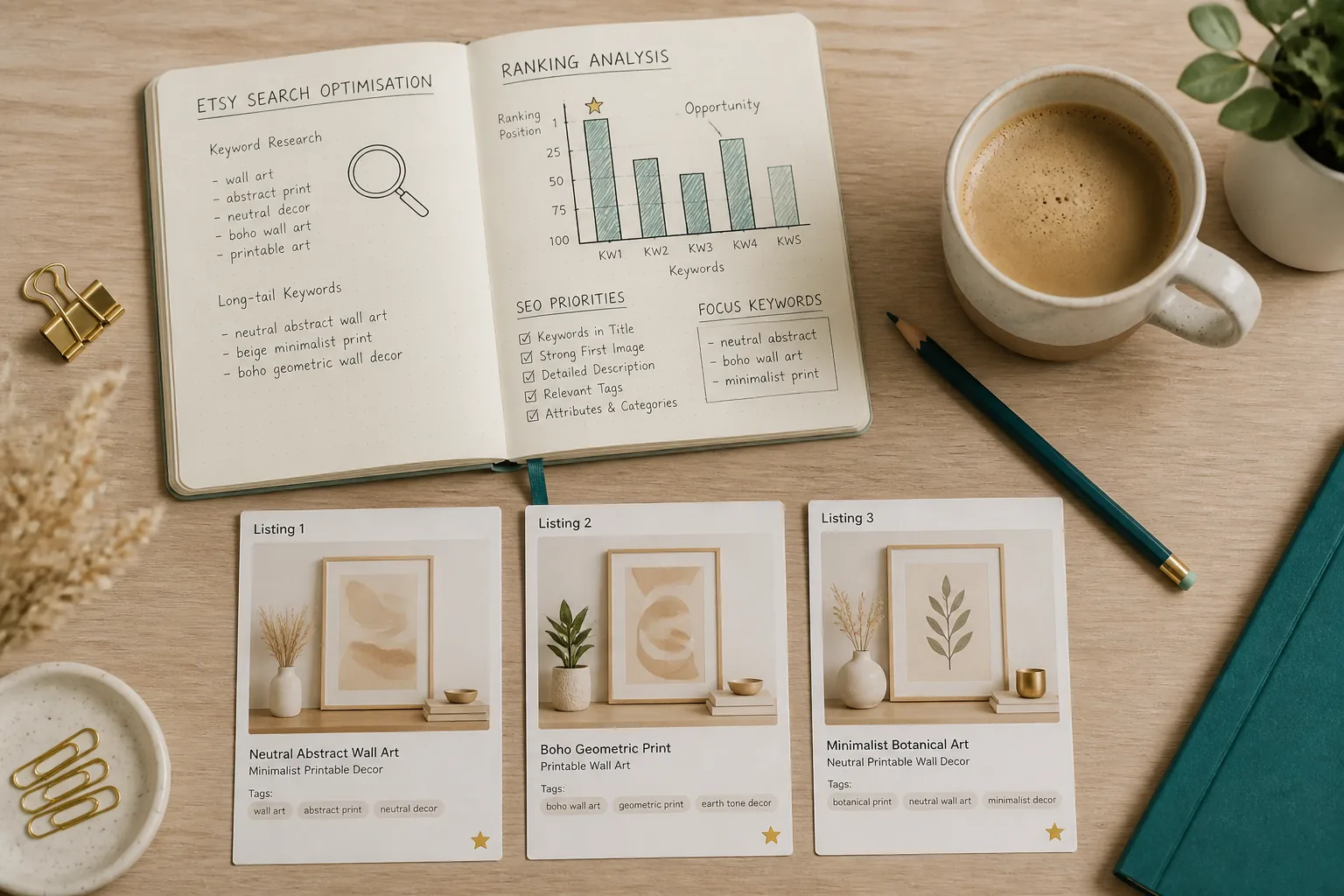
Your listing is live. The photos look good. The price is competitive. And yet when you search for the thing you just made, you can’t find it.
This is a ranking problem, not a product problem, and ranking problems have specific causes you can diagnose one by one. This guide covers the 8 most common reasons Etsy digital product listings don’t show up in search, and what to do about each one.
Work through them in order. Most listings are failing for one or two reasons, not all eight.
1. Your Listing Was Just Published: It’s Not Indexed Yet
What it is: Etsy’s search index doesn’t update in real time. New listings take 24–72 hours to appear in search results after publishing. This is a crawl delay, not a ranking problem.
How to diagnose it: Check when you published. If it’s been less than 72 hours, wait before you change anything.
The fix: Wait it out. If your listing still isn’t showing after 72 hours, move to the next causes. The worst thing you can do is edit the listing repeatedly while the index is still catching up, which can reset the clock.
One thing you can do during this window: share the direct listing URL on social media or in email. External traffic signals (even a small amount) can help Etsy prioritize the listing during indexing.
2. Your Title Doesn’t Match How Buyers Actually Search
What it is: The most common real problem. Your title uses your vocabulary (the words you’d use to describe what you made) rather than the words a buyer types into the search bar.
A watercolour print you describe as “Abstract Botanical Study No. 3, Sage and Cream” might be exactly what a buyer wants. But they’re searching for “sage green wall art printable” or “botanical print boho bedroom”, not “abstract botanical study.”
How to diagnose it: Open Etsy’s search bar and type the first word of your listing title. See what auto-completes. Now type what a buyer who doesn’t know design terminology would type. Are you using any of those phrases?
Also check your Etsy Stats → Traffic → Search Terms for existing listings. What terms are people using to find your shop? Those are your real keywords.
The fix: Front-load your title with the buyer-intent phrase, not the aesthetic description. Lead with what the buyer is solving (“sage green bedroom art printable”) then add the descriptive layer (“watercolour botanical print instant download”). Keep your title under 140 characters and put the most important phrase in the first 40, as that’s what shows in search results.
See the Etsy SEO guide for a full keyword research workflow.
3. Your Tags Are Wasted
What it is: Etsy gives you 13 tag slots. Many sellers burn them on near-duplicates (“botanical print”, “botanical prints”, “botanical wall print”) or terms so broad they’ll never rank (“art”, “print”, “digital”).
How to diagnose it: Write out your 13 tags. For each one, ask: is this a phrase someone types with buying intent? Could I rank for this without paying for ads? Are three of my tags the same phrase with minor variation?
Etsy treats singular and plural as identical, so “botanical print” and “botanical prints” is one wasted slot.
The fix: Use all 13 tags. Empty tags are guaranteed zeros. Mix tag types: 2–3 broad anchor terms (2 words), 7–8 long-tail buyer phrases (3–4 words), and 2–3 occasion or use-case tags (“living room wall art”, “housewarming gift digital”). Make sure at least 5 of your tags don’t repeat words from your title; they should expand your keyword surface, not echo it.
4. Your Thumbnail Isn’t Getting Clicked
What it is: Etsy uses click-through rate (CTR) as a ranking signal. If your listing appears in search results but buyers don’t click it, Etsy interprets that as a relevance or quality signal and depresses the listing’s rank over time.
This means a listing with weaker keyword alignment but a compelling thumbnail will eventually outrank a listing with perfect keywords and a forgettable image.
How to diagnose it: Go to your Etsy Stats and look at views-to-impressions ratio for this listing compared to others in your shop. A ratio below 1.5–2% suggests your thumbnail is losing the click.
The fix: Your thumbnail needs to win at 200px. Test it: open it in a new tab and shrink the browser window until the image is about 200px wide. Does the subject read clearly? Is there enough contrast? Does it look different from the other thumbnails in your niche?
For digital wall art, interior scene mockups almost always outperform plain white backgrounds in search results; they communicate scale, context, and mood at a glance. See the best mockups guide for tested approaches.
Elistit generates up to 20 listing images per listing automatically (mockups plus shop-branded slides), enough variety to test different thumbnail treatments without manually building each one.
5. Your Listing Has No Purchase History: The Cold Start Problem
What it is: Etsy’s algorithm heavily weights purchase velocity and recency. A listing with 50 sales and 10 recent purchases will rank above an identical listing with zero sales, even with the same keywords. This is Etsy’s version of social proof for its algorithm.
New listings are at a structural disadvantage until they accumulate history. This isn’t a bug; it’s a real signal that’s hard to fake.
How to diagnose it: Your listing is new and it’s in a niche with competitors who have 100+ reviews and years of sales history.
The fix: You can’t shortcut real purchase history, but you can accelerate it. Use Etsy Ads with a small daily budget ($1–3/day) on new listings during their first 2–4 weeks; this generates impressions and potential early sales that seed the algorithm. Price competitively during this period. Tell your existing customers about the new listing (email list, social posts).
Also, make sure your existing well-performing listings link buyers toward related new listings via your description. Cross-listing traffic warms up new listings faster than pure organic search.
6. The Niche Is Over-Saturated Without Differentiation
What it is: Some niches on Etsy have 50,000+ listings chasing the same terms. “Boho wall art printable” returns over 100,000 results. If your listing looks like the median result in that niche, you won’t rank. You’ll be one of thousands.
How to diagnose it: Search your primary keyword. Count how many listings have 100+ sales, strong review counts, and have been active for 2+ years. If the top two pages are dominated by established shops, you’re in a high-competition niche.
The fix: Niche down the keyword, not the product. “Boho wall art” → “japandi bathroom wall art printable” or “boho gallery wall set dining room.” These narrower terms have lower competition and buyers searching them are closer to a purchase.
Alternatively, compete on dimension: unique style, format bundle (5-file set at unusual sizes), or a specific room or aesthetic that isn’t well-served. The goal is to be the best result for a specific searcher, not an average result for everyone.
7. Your Listing Quality Score Is Below Average
What it is: Etsy uses a listing completeness and quality score that factors in: whether all attributes are filled, whether the description meets a minimum length and quality threshold, whether you’ve used all photo slots, and whether the listing has consistent signals across title, tags, description, and category.
A listing that’s technically live but sparse on detail will rank below a fully built-out listing for the same keywords.
How to diagnose it: Open your listing in edit mode. Check: Are all attributes filled (material, style, occasion, color)? Is your description over 200 words with the keyword phrase appearing naturally 2–3 times? Have you used at least 5 of the 10 photo slots? Is the listing type set correctly (digital download)?
The fix: Fill in every attribute Etsy offers for your listing type, even if some feel generic (occasion: “just because” counts, color: the dominant tone, style: choose the closest match). Write a description that describes what the buyer receives: file formats, sizes, DPI, what software they need to print, and how to use the files. This isn’t filler; it answers the questions buyers have before they purchase.
The pre-listing SEO checklist walks through every field worth filling.
8. You’ve Listed in the Wrong Category
What it is: Etsy uses category as a ranking signal. A printable assigned to “Prints” instead of “Digital Downloads → Prints” will compete against physical products and get suppressed in digital-only search filters. Category mis-assignment is common with new sellers and often invisible: the listing looks fine, it just ranks against the wrong pool.
How to diagnose it: Click through your live listing and look at the breadcrumb trail at the top (e.g., “Paper & Party Supplies > Paper > Digital Paper”). Does the category match your product precisely? Filter Etsy search for “digital downloads” and check whether your listing appears.
The fix: Edit the listing and re-navigate the category tree from scratch. For digital wall art, the correct path is typically: Art & Collectibles → Prints → Digital Prints. For clipart or SVGs: Craft Supplies & Tools → Patterns & How To → Clip Art. For stickers: Paper & Party Supplies → Stickers.
Don’t stop at the first level; drill to the most specific subcategory available. Etsy’s search filters for “ships from,” “price range,” and “digital downloads” only apply correctly when the category is precise.
Fix These in Order
If you’re working through a listing that isn’t ranking, use this sequence:
- Under 72 hours? Wait. Don’t edit.
- Title check: Does your first phrase match buyer search terms? Use Etsy autocomplete to verify.
- Tag audit: Are all 13 used? Any near-duplicates? Any terms missing from your title?
- Thumbnail test: View at 200px. Does it stand out in the search grid?
- Category check: Are you in the most specific subcategory? Do you appear in digital-download-filtered results?
- Attributes and description: Are all fields filled? Is the description 200+ words and accurate?
- Cold start? Run $1–3/day Etsy Ads for 2–4 weeks to seed purchase history.
- Niche saturation: If competition is heavy, identify a more specific keyword angle.
Most failing listings have problems at steps 2, 3, and 4. Fix the title, fix the tags, and improve the thumbnail, in that order, before touching anything else.
For a complete workflow covering all of these, see the Etsy listing optimization guide.
Quick questions
Quickly answered.
Q.01Why is my Etsy listing not showing up in search?
The most common reasons are: new listings take 48–72 hours to index, your title and tags don't match buyer search terms, low click-through rate is suppressing the listing, or the listing lacks engagement signals (favorites, purchases) compared to older competitors.
Q.02How long does it take for a new Etsy listing to rank?
New listings typically appear in search within 48–72 hours, but competitive ranking can take 2–8 weeks as Etsy collects click and purchase data. Digital product listings with strong keyword alignment can rank within days in low-competition niches.
Q.03Does renewing an Etsy listing help it rank?
Temporarily. Renewed listings get a brief freshness boost, but it fades within days. It is not a substitute for fixing titles, tags, and click-through rate. Spend the renewal fee on improving the listing instead.
Q.04What Etsy listing quality signals matter most for ranking?
Click-through rate from search results, conversion rate (views to sales), and recent purchase velocity are the strongest signals. An optimized thumbnail that earns clicks is often more impactful than any keyword change.
Q.05Does Etsy penalise listings for using AI-generated images?
Etsy requires disclosure of AI-generated content via the attribute selector, but does not algorithmically penalise compliant listings. Undisclosed AI content can lead to removal. Disclosed AI listings rank on the same signals as any other listing.
Keep going.
Etsy Competitiveness & Search Volume: Reading the Signals Before You List
An Etsy competitiveness score reads how contested and searched a keyword is. How to interpret the signals and pick keywords you can actually rank for.
How to Write Etsy Descriptions That Rank and Convert
Most Etsy descriptions are either keyword dumps or content-free. The structure that does both jobs: satisfies the algorithm and sells the buyer.
Etsy Listing Quality Score Explained: What It Is and How to Improve It
Etsy doesn't show a quality score number, but it scores your listings. What feeds that score and how to raise it for better search placement.
Etsy Listing Renewal Strategy: When It Helps, When It Wastes Money
An Etsy listing renewal strategy that actually works: when renewal moves the needle and when to spend that time fixing the listing instead.