Etsy Listing Quality Score Explained: What It Is and How to Improve It
Etsy doesn't show a quality score number, but it scores your listings. What feeds that score and how to raise it for better search placement.
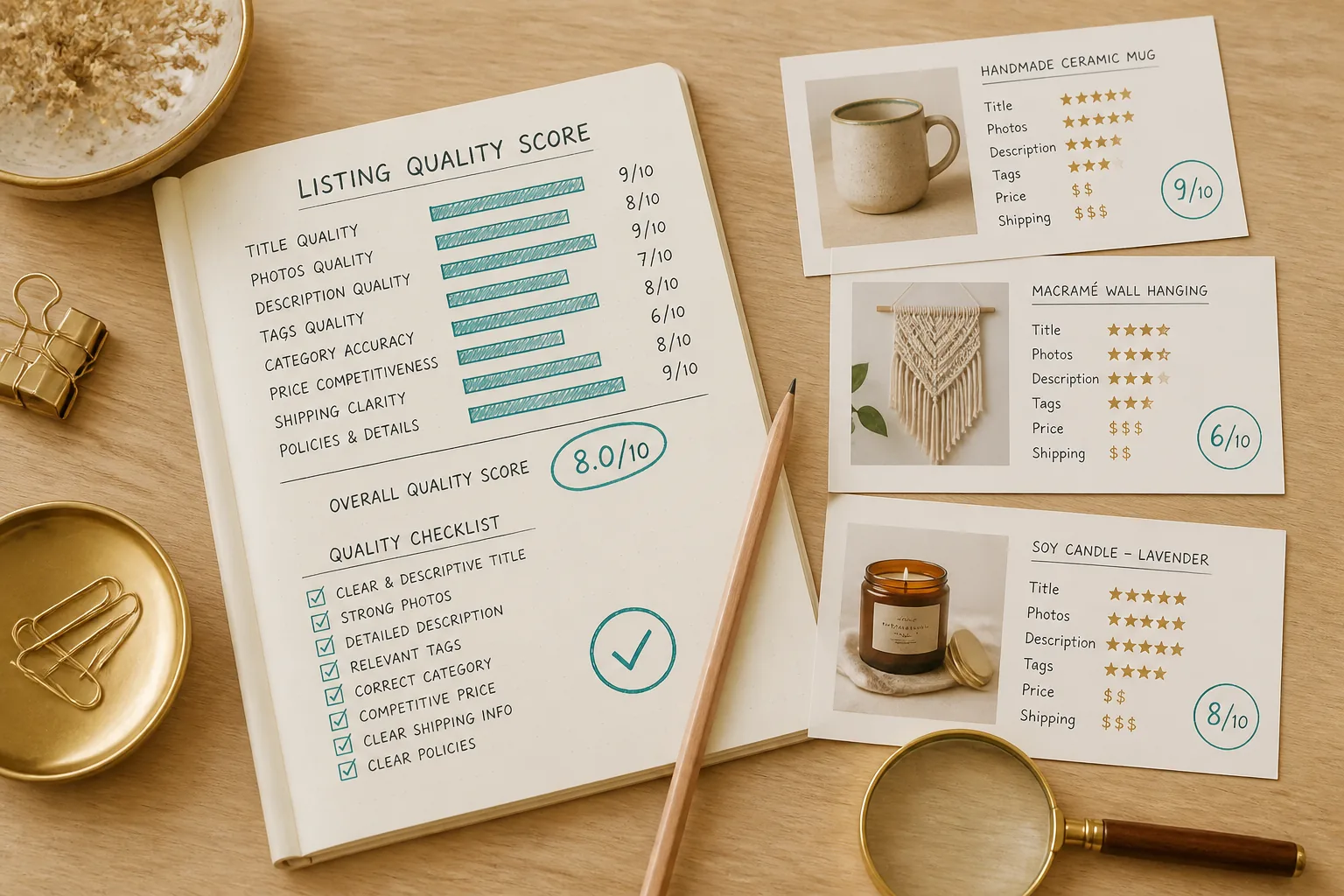
There’s no box in your Etsy dashboard that reads “Quality Score: 84.” That’s why sellers argue about whether it even exists. It does. Etsy just doesn’t hand you the number. The algorithm continuously scores how good each listing is at converting search traffic, and it expresses that score as your position in search results. You read it backwards, through your Stats, not forwards through a meter.
Once you stop looking for a number and start watching the signals that feed it, the whole thing becomes manageable. What drives Etsy’s quality assessment, and where to spend your effort:
Clearing Up the Misconception
The “Etsy quality score” people search for is a borrowed concept. Google Ads has a literal Quality Score you can see. Etsy does not. What Etsy has is a ranking system that weighs listing quality as one of its inputs. That weight is heavy, but invisible.
So when a guide tells you to “improve your quality score,” what it really means is: improve the behavior-and-completeness signals Etsy uses to decide where you rank. There’s no setting to toggle and no gauge to watch. There’s only the search position your listing earns, and the handful of measurable inputs that move it.
What Actually Feeds the Score
Etsy’s listing-quality assessment runs on a few core signals:
- Click-through rate from search: of the people who see your thumbnail in results, how many click.
- Conversion rate: of the people who land on the listing, how many buy.
- Recency and sales velocity: recent sales and steady engagement count more than old, stale activity.
- Listing completeness: photos, attributes, description, video all filled in.
- Customer-experience signals: reviews, message responsiveness, low cancellation and dispute rates.
Everything else sellers fuss over (renewals, posting times, tag tweaks) only matters insofar as it moves one of these. Click-through and conversion are the two that dominate.
Why Click-Through Rate Is the Dominant Lever
Etsy ranks by relevance first, but relevance only gets your listing shown. What happens next decides everything. Etsy displays your thumbnail to a sample of searchers and measures whether they click. High click-through is the algorithm’s strongest early read that your listing matches what people want, so it widens distribution. Low click-through tells it the opposite, and the listing sinks regardless of how perfect the tags are.
That makes the thumbnail your highest-leverage asset. Not the keywords; the image. For digital wall art, clipart, and posters, the thumbnail is the entire first impression in a grid of competitors. Crisp framing, strong contrast at small sizes, and a clear sense of the product beat a beautiful image that turns to mush at thumbnail scale. Improve the thumbnail and you improve the one signal everything else hangs from.
How Conversion Rate Compounds Ranking
Click-through gets you shown more; conversion keeps you climbing. When Etsy sees that the traffic it sent bought, it treats your listing as a proven match and promotes it further. More promotion means more views, more views at a healthy conversion rate means more sales, and the listing rides its own momentum upward.
This is why conversion is worth obsessing over. The things that move it (clear pricing, a description that answers the obvious questions, mockups that show the product in context, honest sizing and format details) don’t just make individual sales. Each sale feeds the velocity signal that lifts the listing for the next searcher. A listing that converts well is, in effect, marketing itself to the algorithm.
The Completeness Checklist
This is the part you control completely, so max it out:
- All photo slots used: fill every available image slot with a useful angle, mockup, or detail.
- Every relevant attribute selected: color, orientation, file type, style, occasion; don’t leave attributes blank.
- A full description: not three lines. Cover what it is, what’s included, sizes, formats, and use.
- A video where it fits: even a simple one lifts engagement and completeness.
- All tags used: fill all available tag slots with distinct, buyer-aligned phrases.
Etsy reads a fully-built listing as higher quality and a buyer reads it as more trustworthy. Both effects push the same direction.
What Hurts Quality
- Canceled orders and disputes: direct negative signals on customer experience.
- Poor or thin reviews: they suppress both ranking and conversion.
- Incomplete listings: empty photo slots, blank attributes, skeletal descriptions.
- Slow message response: Etsy tracks responsiveness as a shop-quality factor.
- Stale listings with no recent engagement: velocity decays, and so does position.
None of these are exotic. They’re the predictable ways a listing tells Etsy it’s a weaker bet than the competitor next to it.
How Customer Experience Feeds the Score
The signals beyond click and conversion are easy to forget because they happen after the sale, but Etsy weighs them. A listing attached to a shop with canceled orders, slow message replies, and thin or negative reviews carries that baggage into search. The algorithm is protecting buyer trust, and a shop that creates friction is a worse bet to show.
For digital sellers this is mostly about the post-purchase experience being clean: files that download exactly as promised, sizes and formats that match the description, and quick answers when someone messages about printing. Each smooth transaction earns a review, and reviews do double duty: they lift conversion for the next buyer and they feed the shop-quality signal that supports every listing you have. One unresolved complaint can quietly drag down listings that had nothing to do with it.
Reading the Score Through Your Stats
Since there’s no number to look at, your Etsy Stats panel is how you read the quality signal indirectly. Three figures tell the story. Impressions show how often Etsy is putting your listing in front of searchers. Click-through rate shows whether the thumbnail is winning the click. Conversion rate shows whether the listing closes once someone lands.
Diagnose from the pattern. High impressions but low click-through means the thumbnail is the problem. Etsy is giving you the chance and the image isn’t taking it. Healthy click-through but low conversion means the listing page is letting buyers down (pricing, description, mockups, or trust). Low impressions across the board means relevance is the bottleneck and the keyword work comes first. You’re effectively reverse-engineering the invisible score from the three numbers it leaves behind.
How New Listings Build Quality Over Time
A brand-new listing has no click or purchase history, so Etsy can’t score its behavior yet. For the first 48 to 72 hours it’s indexing; for the first few weeks it leans on relevance and completeness while it gathers data. As real clicks and sales accumulate (typically over a 2 to 8 week window), the behavioral signals take over and the listing finds its true position.
The practical takeaway: don’t kill a listing in week one. Get the thumbnail and completeness right at launch so it has the best possible starting relevance, then watch the trend over a month. Tweak the thumbnail if click-through is weak, tighten the listing if clicks aren’t converting, and let velocity compound from there.
A Practical Order of Operations
When a listing underperforms, work the signals in the order Etsy weighs them rather than tweaking at random. First confirm relevance: are you even being shown? If impressions are low, the keyword and tag work comes before anything else, because nothing downstream matters if you’re not surfacing. Second, fix the thumbnail: if impressions are healthy but click-through is weak, the image is leaving traffic on the table, and it’s the highest-impact change you can make. Third, fix the page: if clicks are landing but not converting, look at pricing, description completeness, mockups, and reviews. Fourth, protect the experience: keep cancellations and slow replies from dragging the whole shop.
This sequence matters because the signals build on each other. There’s no point perfecting your description for a listing nobody clicks, and no point polishing a thumbnail for a keyword nobody searches. Diagnose top-down, fix the binding constraint first, and let each fix feed the next. A listing that’s relevant, clicked, and converting accumulates the velocity that lifts it. That’s the quality score doing its job, even though you never see the number.
Where to Go Next
- Why Your Etsy Listings Aren’t Ranking: the common causes when quality signals aren’t translating into search position.
- Etsy Thumbnail Optimization: how to win the click that drives every other signal.
- Etsy SEO: getting the relevance right so quality signals have something to build on.
Quick questions
Quickly answered.
Q.01Does Etsy show a listing quality score I can look at?
No. There's no number in your dashboard labeled 'quality score' the way Google Ads shows one. But Etsy's search ranking absolutely scores listing quality behind the scenes; it just expresses the result as where you land in search, not as a visible figure. The score is real; the dashboard readout isn't. You read it indirectly through impressions, click-through rate, and conversion rate in your Stats.
Q.02What's the single biggest lever on Etsy listing quality?
Click-through rate from search, which is driven almost entirely by your thumbnail. Etsy shows your listing to a batch of searchers and watches whether they click. A thumbnail that earns clicks tells the algorithm your listing matches intent, and Etsy responds by showing it to more people. You can have flawless tags and still get buried if nobody clicks the image, so the thumbnail is where quality work pays off first.
Q.03How does conversion rate affect ranking?
It compounds. Click-through rate gets you shown more; conversion rate (views turning into sales) keeps you there. When Etsy sees that the traffic it sends you buys, it reads your listing as a strong match and pushes it higher, which sends more traffic, which produces more sales. A listing that converts well climbs on its own momentum. One that gets clicks but no sales stalls.
Q.04Do incomplete listings hurt my quality score?
Yes. Listing completeness is a direct input: all photo slots filled, every relevant attribute selected, a full description, and a video where it fits. Etsy favors listings that give buyers and the algorithm complete information, and a half-filled listing signals lower quality. It's the easiest factor to max out because it's entirely in your control; no waiting on buyer behavior.
Q.05How long does it take a new listing to build quality?
Expect 48 to 72 hours to index and 2 to 8 weeks to accumulate enough click and purchase data for Etsy to score it confidently. New listings start with little history, so they lean heavily on relevance and completeness at first; as real engagement data arrives, click-through and conversion take over as the dominant signals. Don't judge a listing in week one. Judge the trend over the first month or two.
Keep going.
Etsy Competitiveness & Search Volume: Reading the Signals Before You List
An Etsy competitiveness score reads how contested and searched a keyword is. How to interpret the signals and pick keywords you can actually rank for.
How to Write Etsy Descriptions That Rank and Convert
Most Etsy descriptions are either keyword dumps or content-free. The structure that does both jobs: satisfies the algorithm and sells the buyer.
Etsy Listing Renewal Strategy: When It Helps, When It Wastes Money
An Etsy listing renewal strategy that actually works: when renewal moves the needle and when to spend that time fixing the listing instead.
Etsy SEO for Clipart Bundles: How to Rank When Thousands of Sellers Sell the Same Themes
Clipart SEO on Etsy is won in the long tail: specific subjects, licensing clarity, and buyer-intent titles. The exact strategy, step by step.