How to Write Etsy Descriptions That Rank and Convert
Most Etsy descriptions are either keyword dumps or content-free. The structure that does both jobs: satisfies the algorithm and sells the buyer.
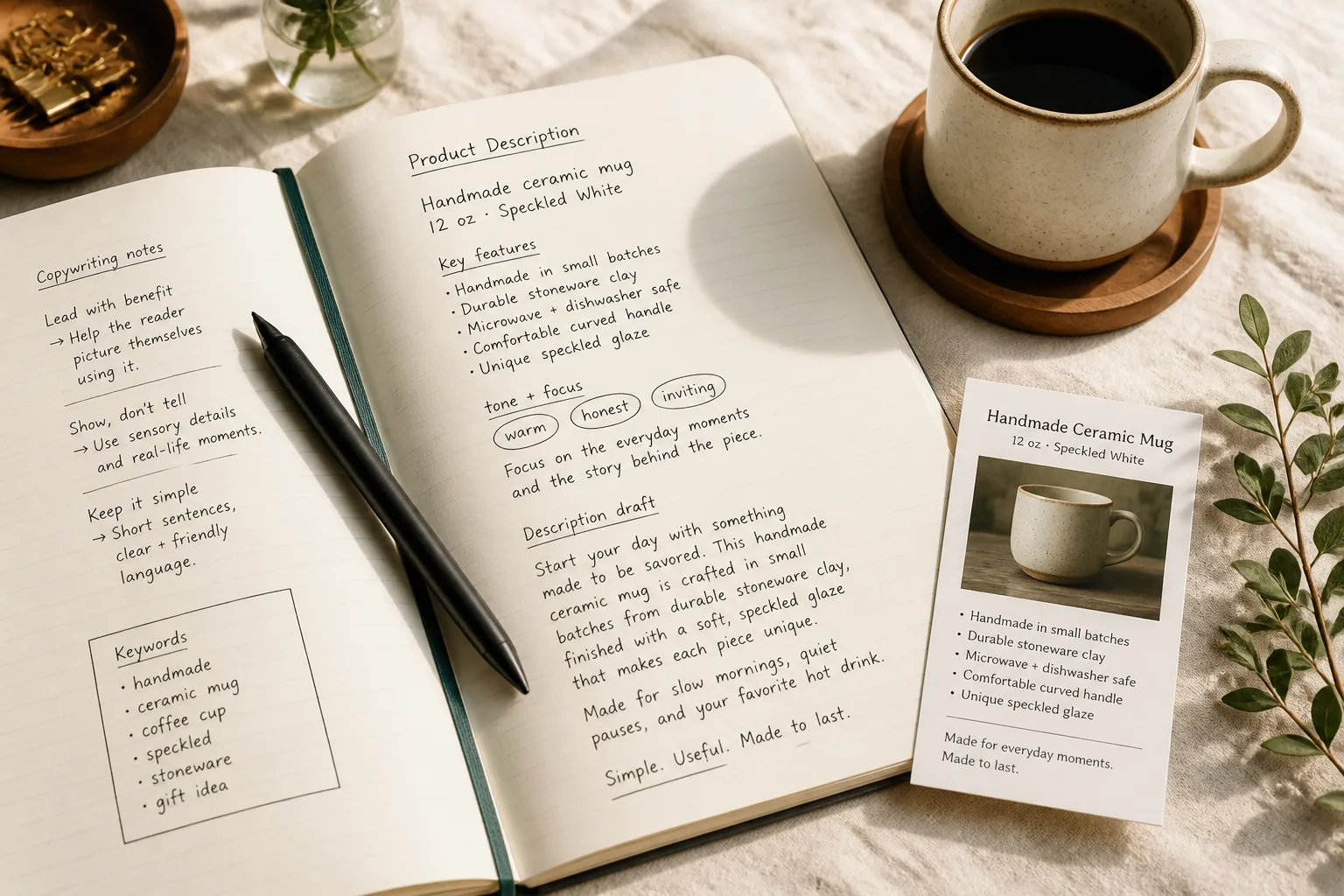
How Etsy Uses Description Text
Etsy is direct about this: titles and tags are the primary ranking signals. The description is indexed but carries less weight. That framing leads many sellers to either ignore descriptions entirely (which wastes the indexing opportunity) or treat them as a secondary keyword dump (which satisfies neither the algorithm nor the buyer).
The description’s real job is two things simultaneously: extend your keyword coverage into long-tail queries, and convert the buyer who’s already clicked through.
Someone who searched “minimalist botanical print set of 3” and clicked your listing has already expressed intent. The description is where you close: remove their remaining doubts, confirm what they get, and give them a concrete reason to add to cart.
On the indexing side, descriptions let you capture phrasing that won’t fit in your 140-character title. A buyer searching “black and white botanical wall art for bathroom” is using a phrase that’s too long for a title but fits naturally into a sentence of description copy.
The first 160 characters of your description are indexed most heavily and appear as previews in certain Etsy mobile contexts. This is where your primary keyword should appear, in context, not bolted on.
Buyers Scan, They Don’t Read
Track eye movement studies on e-commerce product pages and the pattern is consistent: buyers scan headlines, bullet points, and the first sentence of paragraphs. They stop at specific numbers (file sizes, dimensions, piece counts). They look for answers to specific concerns (will this fit my frame? is this for commercial use?).
A paragraph-heavy description is almost invisible to this scanning behavior. A 300-word unbroken block of text, regardless of how good the writing is, loses most buyers before they reach the key information.
Practical implication: break descriptions into scannable units. Use line breaks between sections. Use bullets for specification lists. Put the most important information where it’s hardest to miss: the first sentence and any bolded or bulleted element.
The 5-Part Description Structure
1. Hook Sentence
Not a welcome message. Not “This listing is for…” (that wastes the most-indexed real estate).
Write a single sentence that describes what the product is and who it’s for. Pack your primary keyword in naturally.
Example: “A set of 3 botanical wall art prints in a minimal black-and-white palette, sized for standard IKEA RIBBA and SANNAHED frames.”
That sentence names the product, the quantity, the style, the color, and the frame compatibility, all in one scannable line.
2. What They Get
List the deliverables precisely. For digital products, this means:
- Number of files included
- File formats (PDF, JPG, PNG, SVG, etc.)
- Pixel dimensions and DPI
- Aspect ratios
- Any included variants (both landscape and portrait, multiple colorways)
Buyers purchasing digital products are solving a specific problem: they need a file that works for a particular use. Vague delivery information (“high-quality files included”) leaves them uncertain and doesn’t answer the question.
3. Specs and Technical Details
For printable wall art: “5 files included (5×7, 8×10, 11×14, A4, A3), all at 300 DPI in CMYK color profile, ready for home printing or professional print services.”
For clipart bundles: “28 PNG files on transparent backgrounds, 3000×3000 px at 300 DPI. SVG files included for each element.”
For SVG cut files: “SVG, PNG, DXF, and EPS formats included. Tested in Cricut Design Space and Silhouette Studio.”
Specs reduce refund requests and build buyer confidence simultaneously.
4. Use Case Context
Help buyers picture the product in their life. Not vague and aspirational. Specific scenes and specific applications.
“Works well in a gallery wall with neutral frames, as a set grouped above a desk, or as individual prints in a bathroom or bedroom. Print at home or upload directly to Printful, Printify, or a local print shop.”
For clipart: “Suited for small business branding, scrapbooking, teacher materials, and party printables.”
Use case sentences often capture long-tail search queries naturally (“printable wall art for bathroom,” “clipart for teacher materials”) without forcing keywords.
5. Rights and License
Digital product buyers consistently ask about licensing. If they don’t find the answer in the listing, they often don’t buy. State the license terms explicitly in the description.
Personal use: “For personal, non-commercial use only. Not for resale, redistribution, or use in commercial products.”
Commercial use: “Includes a commercial license. You may use these files in products for resale (cards, mugs, print-on-demand items). Redistribution or resale of the files themselves is not permitted.”
One clear paragraph prevents most license-related messages and removes a purchase barrier for commercial buyers who won’t buy without explicit permission.
Keyword Placement That Works
The first 160 characters are indexed most heavily. Place your primary keyword phrase here.
The first 40–60 words should contain your primary keyword plus one or two secondary variations (e.g., “botanical wall art” and “plant print set”).
Through the body of the description, use natural-language variations of your keyword. “Botanical prints,” “plant wall art,” “nature-themed prints”: each variation catches a slightly different buyer query without repeating the exact phrase mechanically.
Avoid keyword density over approximately 3%. If the same phrase appears every 30 words, Etsy’s systems may flag the listing.
The SEO Paragraph Technique
Write one paragraph that directly answers the most common buyer question implied by your primary keyword.
For “botanical wall art for living room”: write a paragraph that talks about sizing prints for living room gallery walls, frame sizes, and print placement, naturally incorporating the keyword while genuinely answering the question.
This paragraph doesn’t need to be labeled as anything. It reads as useful product information. But it functions as a long-tail SEO block, matching the conversational queries that buyers type when they’re close to purchasing.
What Kills Conversion
Feature-not-benefit writing. “300 DPI resolution” is a feature. “Prints sharp at any size up to poster format, including A2” is the benefit. Lead with what it means for the buyer.
Missing delivery information. “Instant download” is not sufficient. Tell buyers exactly what arrives in their downloads folder: number of files, formats, and what they need to open them.
Paragraphs over bullets for specs. A 6-line paragraph listing file formats and sizes forces buyers to read carefully to extract the relevant detail. A 6-item bullet list takes 5 seconds to scan.
Generic openers. “Welcome to my Etsy shop! I am so excited to share this product with you.” This wastes the indexed real estate and delays the buyer’s answer. Cut it entirely.
Elistit’s 8-Stage Listing Copy Pipeline
Writing descriptions that do both jobs (index well and convert) requires knowing what buyers actually search and how to structure product information for scanning behavior. Elistit’s listing copy generator produces title, 13 tags, and description in one pass, structured around the 5-part framework above with keyword placement calibrated to Etsy’s indexing behavior.
The output includes a hook sentence, spec block, use-case paragraph, and license statement: the components that tend to be missing from seller-written descriptions. See how Etsy SEO fundamentals and listing optimization work together, and use the pre-listing SEO checklist before publishing.
Quick questions
Quickly answered.
Q.01Does Etsy use the description for search ranking?
Etsy has confirmed that descriptions are indexed but are a secondary ranking signal compared to titles and tags. They matter most for long-tail queries (multi-word, specific search phrases) where the title and tags don't fully cover the buyer's exact phrasing. The first 160 characters carry the most weight.
Q.02How long should an Etsy product description be?
400–600 words covers most digital products without losing buyers who scan. Under 150 words leaves ranking opportunities on the table and gives buyers too little to act on. Over 800 words dilutes the key information and rarely gets read. The exception is complex products (SVG files, bundles with multiple components) where buyers genuinely need specification detail.
Q.03Should I repeat keywords from my title in the description?
Yes, but naturally. Etsy's algorithm looks for keyword consistency across listing fields. If your title includes 'botanical wall art print,' use that phrase or close variants in the description. Avoid stuffing the same phrase 6 times. Write it in context, as you'd explain the product to a buyer.
Q.04What's the most important part of an Etsy description?
The first sentence. It's visible in some Etsy mobile views as a preview, and buyers who click through scan it before deciding whether to read further. Lead with the most concrete, buyer-relevant fact: what the product is, what format it comes in, and the primary use case. Not 'Welcome to my shop.'
Q.05Can Etsy descriptions hurt my ranking?
An empty or near-empty description is a missed indexing opportunity. A description full of unrelated keywords or repeated phrases can trigger Etsy's spam detection and negatively affect your listing quality score. Write for the buyer first; the algorithm follows.
Keep going.
Etsy Competitiveness & Search Volume: Reading the Signals Before You List
An Etsy competitiveness score reads how contested and searched a keyword is. How to interpret the signals and pick keywords you can actually rank for.
Etsy Listing Quality Score Explained: What It Is and How to Improve It
Etsy doesn't show a quality score number, but it scores your listings. What feeds that score and how to raise it for better search placement.
Etsy Listing Renewal Strategy: When It Helps, When It Wastes Money
An Etsy listing renewal strategy that actually works: when renewal moves the needle and when to spend that time fixing the listing instead.
Etsy SEO for Clipart Bundles: How to Rank When Thousands of Sellers Sell the Same Themes
Clipart SEO on Etsy is won in the long tail: specific subjects, licensing clarity, and buyer-intent titles. The exact strategy, step by step.