Celestial Wall Art for Etsy: Designs, Trends, and What Sells in 2026
Moon phases, star maps, zodiac prints: what celestial buyers want on Etsy and how to create high-converting celestial wall art listings.
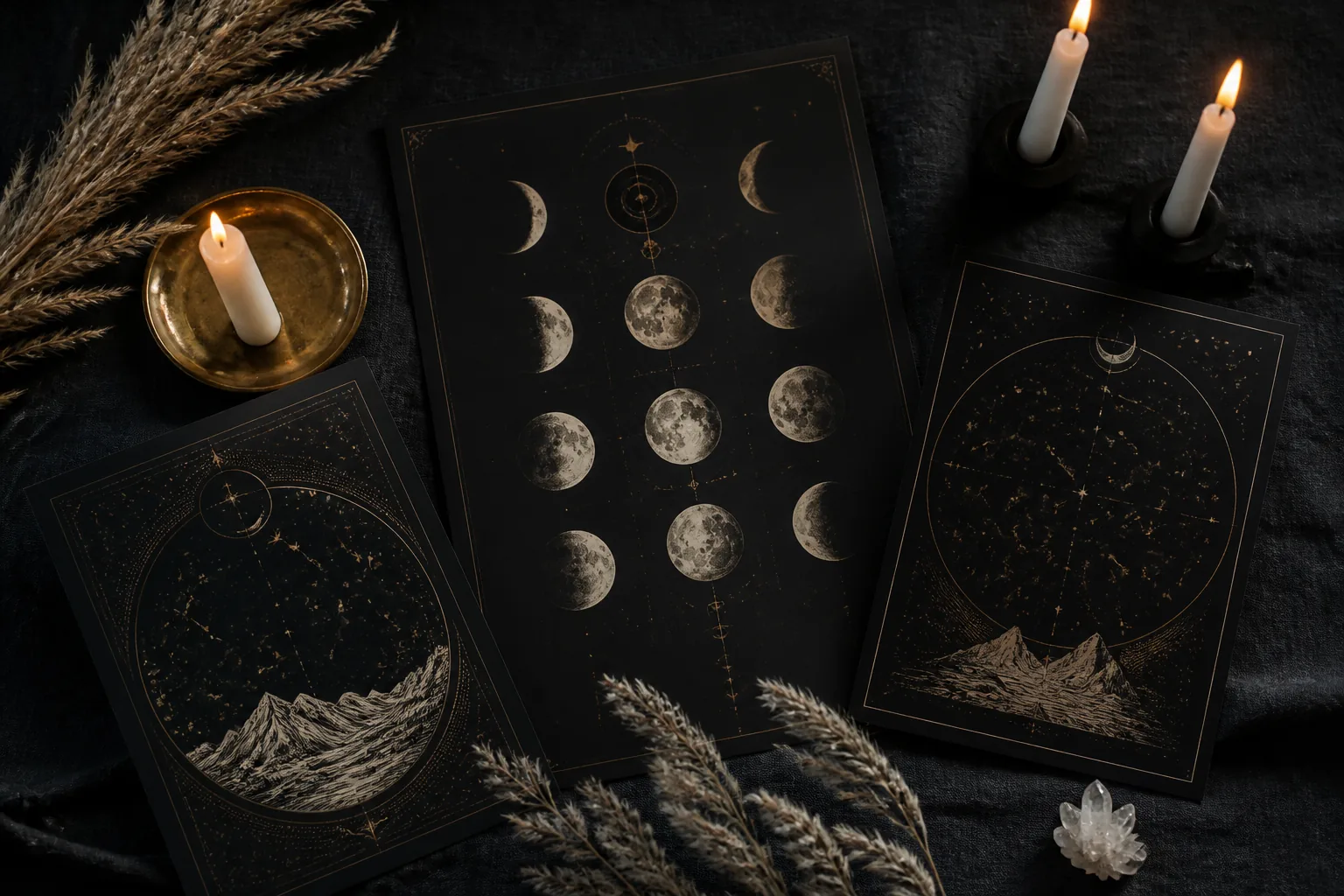
Celestial wall art is one of Etsy’s most durable digital print niches. It predates the cottagecore wave, survived the 2022–2023 aesthetic fatigue cycle, and continues to hold search volume because the buyer base is genuinely diverse: astrology enthusiasts, interior decorators, gift shoppers, people who want a statement piece for a dark living room wall. The niche isn’t going anywhere.
What has changed is the level of competition. Search “moon phase print” on Etsy and you’ll find thousands of listings. The shops winning in 2026 are the ones with distinctive visual styles, strong thumbnail differentiation, and listings structured for the right keywords. Generic moon circle art on a dark background isn’t a business. It’s a listing that gets buried.
The buyers are mostly women 22–40, with a secondary demographic of gift-buyers (partners, friends buying something “personal” for someone who mentions astrology). The aesthetic skews dark and dramatic (deep navy, black, gold, dusty plum) but there’s a sub-market for lighter, more boho celestial art in cream and terracotta.
What Sells in the Celestial Niche
Moon phase charts. The classic horizontal row of 8 moon phases from new moon through full and back is the anchor product of this niche. It sells year-round, works as statement art in living rooms, bedrooms, and home offices, and benefits from a wide range of aesthetic treatments: minimalist line art, detailed realistic illustration, bohemian vintage style, fine art abstract. Your moon phase chart needs to be visually distinctive to compete; a generic circle row in white on black is not a product in 2026.
Zodiac constellation prints. Individual constellation art for each of the 12 signs, sold as individual listings. These benefit from personalizability (buyers purchase their own sign or a partner’s), build a natural 12-listing series, and have strong gifting demand around birthdays. Constellation maps with clean gold linework on dark navy are the dominant visual style and still convert, but there’s opportunity in cream/parchment vintage style for buyers who want something lighter.
Star maps. Custom “the night sky on [date and location]” prints for anniversaries, births, weddings. These are personalized products requiring a different workflow than static prints, but they command higher prices and have gift-buyer demand. If you offer personalization, clearly show a completed example in your first listing photo; buyers need to see what they’re ordering before they commit.
Sun and moon face art. Celestial face art (the sun with a human face, moon in profile) is a recurring trend that never fully leaves this niche. It works in line art style, vintage engraving style, and watercolour. Paired sun and moon sets are particularly popular for bedroom decor.
Galaxy and nebula art. Deep space imagery (nebulae, galaxies, planetary formations) works well as large format statement prints. The 24×36 size is common here. This sub-niche is more competitive since AI image tools make it easy to generate galaxy imagery, but distinctive compositions (a specific nebula, a named galaxy cluster) beat generic “space art.”
Palettes that convert: Deep navy + gold, black + white, charcoal + dusty plum + silver, dark forest green + cream + gold. The lighter sub-niche uses cream + sage + terracotta and attracts boho buyers who want celestial without the dark drama.
What Doesn’t Sell / Common Mistakes
Generic dark background + white circles. If your moon phase chart is just 8 white circles in a row on a black background with no additional design elements, you’re invisible. Add texture, linework detail, constellation overlay, typography, or frame it differently.
Zodiac symbols without supporting design. The symbol alone (♈, ♉, etc.) isn’t enough. Pair it with the constellation, include the glyph name and dates, add decorative framing. Buyers want something that feels like an artifact, not a symbol chart.
Overpricing the non-personalized products. Buyers comparing a $12 non-personalized moon phase print to a $5 competitor will choose based on visual quality, not price anchoring. You can charge more, but only if your visual differentiation is obvious at thumbnail size.
Titles that lead with the aesthetic instead of the product. “Celestial Art Print | Moon Phase Printable Wall Art” converts better than “Mystical Moonrise Nightscape Celestial Art.” Buyers search for the product type, not your product name.
Missing large format sizes. If you only offer 5×7 and 8×10 for celestial art, you’re losing buyers who want a statement piece. Include 18×24 and 24×36 at minimum. The wall art ratio guide covers how to set up artboards for these large poster sizes without quality loss.
Technical Specs for This Niche
Celestial buyers are more likely than other wall art buyers to send files to a professional print shop (Printful, Walgreens, Costco Photo) because they want large format prints. This has implications for your file specs.
Resolution: 300 DPI at the output size. A 24×36 at 300 DPI is a large file. Check the 300 DPI guide for how to verify and export at large format without quality loss; a pixelated star map printed at poster size is a one-star review.
Recommended sizes: 8×10, 11×14, 18×24, 24×36 inches. A4 and A3 for European buyers. Square formats at 12×12 and 20×20.
File formats: High-quality JPEG (300 DPI, sRGB) for most uses. PDF for designs with bleed or border. If you’re selling star maps or detailed constellation art, a ZIP with multiple sizes is expected.
Color space: sRGB. Dark backgrounds can look significantly different in CMYK; stay in sRGB and note in the listing description that colors may vary slightly between screen and print depending on the buyer’s printer calibration.
Bleed and trim: If the design has a black or dark background that extends to the edge, include bleed marks or at least note in the description how to set up printing without a white border. Dark-background prints that print with an unwanted white border generate avoidable support messages.
Etsy SEO for the Celestial Niche
Title pattern:
[Subject] Printable Wall Art | [Style Descriptor] [Celestial Term] Print | Digital Download | [Size reference]
Example: Moon Phase Printable Wall Art | Minimalist Celestial Chart Print | Navy Gold Digital Download | 8x10 18x24 A4
Tags that convert: “moon phase print,” “celestial wall art,” “zodiac printable,” “star map print,” “moon phase chart,” “mystical wall art,” “astronomy print,” “constellation art,” “dark academia decor” (overlap niche), “galaxy print.” Use size-specific tags (“18x24 printable,” “large format wall art”) to capture buyers already filtering by size.
The zodiac sign opportunity: If you’re creating individual zodiac constellation prints, each listing should have the sign name prominently in the title and tags. “Scorpio constellation print” is a low-competition long-tail keyword with buying intent. Do all 12 signs as separate listings, not one listing with 12 variations; each gets indexed independently.
Seasonal listing strategy: Publish moon phase and eclipse prints at least 6 weeks before a major astronomical event. Check NASA’s published calendar for full moons, supermoons, and eclipses and schedule uploads accordingly. For the December/January zodiac gift spike, new listings need to be indexed by mid-November. The full Etsy SEO guide covers indexing timelines in more detail.
AI Art and the Celestial Niche
Celestial art is heavily represented in AI image generation; it’s one of the most-trained aesthetics. The upside is that you can generate distinctive celestial prints quickly. The downside is that generic prompts (“full moon phases, dark background, gold details”) produce average-looking results that match what 10,000 other sellers have already tried.
The differentiation comes from style specificity in your prompts and post-processing. A prompt for a vintage engraving style celestial chart, complete with aged paper texture and copperplate-style linework, produces something different from the standard digital art output. Combining AI generation with a defined style guide (specific color hex values, consistent linework weight, recurring decorative elements) lets you build a shop aesthetic that’s recognisable across listings.
Tools like Elistit are built for this workflow: describe a specific celestial design, receive 300 DPI print-ready files across standard ratios in under 15 minutes, with consistent styling across designs in a series. For sellers building a 12-sign zodiac collection, this matters: all 12 prints need to look like they belong together.
Building a Celestial Shop That Compounds
The celestial niche rewards series and collections more than most. A buyer purchasing their birth sign constellation print is likely to buy the moon phase chart if they love your shop. A buyer who receives a star map as a gift and reviews it positively will find the shop through Etsy recommendations.
Structure your shop as a catalog, not a collection of individual prints. Group by series in your section headers. Use Etsy’s “you might also like” by linking related listings in your descriptions. Price bundles to lift average order value: “moon and sun matching set,” “full 12-sign zodiac collection.”
The ceiling in this niche is real for sellers with undifferentiated products. But shops with distinctive visual style and strong series structure consistently build review counts and repeat customers. The category is competitive, not closed.
Related aesthetics
- Boho Wall Art: the lighter cream-and-terracotta celestial sub-market lives here.
- Dark Academia Wall Art: the dark, dramatic palette celestial buyers also browse.
Quick questions
Quickly answered.
Q.01Which sells better on Etsy: moon phase prints or zodiac prints?
Moon phase prints have broader, more consistent search volume because they appeal to buyers regardless of their sign. A full moon phase chart is a single product that any buyer can purchase. Zodiac prints have 12x the SKU count (one per sign) but buyers only buy one: their sign. If you're starting out, moon phase prints let you test the niche with fewer listings. Once you have traction, adding zodiac prints expands reach significantly because each sign creates a separate keyword cluster.
Q.02What sizes do celestial print buyers typically want?
18x24 inch and 24x36 inch are unusually popular in this niche compared to most wall art categories; celestial buyers want statement pieces, not small accents. 8x10 and 11x14 are still standard, but if you're only offering 5x7 and 8x10 you're missing a significant portion of demand. Square formats (12x12, 20x20) work well for moon phase charts displayed centered on a feature wall. Always include the A4 size for European buyers, who are a large share of this niche.
Q.03Does celestial art have seasonal demand peaks?
Yes, with two clear patterns. The first is late December into January; new year buyers are purchasing zodiac and star sign art, often as gifts. The second is the period around major astrological events: a well-publicised full moon, eclipse, or planetary event generates a search spike for related art. Sellers who have moon phase and eclipse prints already indexed before these events capture the traffic. Valentine's Day also produces a spike for personalized star map and 'our night sky' prints.
Q.04Do I need to disclose AI-generated art on Etsy for celestial prints?
Etsy's current policy (2026) requires sellers to disclose when AI tools are used in creating a listing. In practice, disclosure should appear in your listing description, not in the title or tags. The celestial niche is reasonably AI-tolerant; buyers care more about print quality and aesthetic than production method. State clearly that the artwork is AI-generated and digitally enhanced. Listings that hide AI involvement and then receive a complaint from a buyer are at higher risk of shop action than listings with transparent disclosure.
Q.05What's the right price point for celestial wall art printables?
Single moon phase charts: $4–$7. Individual zodiac sign prints: $3–$5. Full zodiac sets (all 12 signs): $15–$22 and convert well because gift-buyers purchase the full set. Personalized star maps (custom date and location) command $8–$15 for a single print but require personalization workflow. If you're selling non-personalized celestial art, stay competitive at $4–$6 for singles; the category has significant price pressure from high-volume shops. Bundle 3–4 coordinated celestial prints for $10–$14 to lift average order value.
Keep going.
Botanical Wall Art for Etsy: What Sells, What's Oversaturated, and How to Stand Out
Botanical is one of Etsy's most competitive niches. How to find the undersaturated sub-niches and create botanical prints that actually rank.
Boho Wall Art for Etsy: Designs That Sell in 2026
Complete guide to creating profitable boho wall art for Etsy. Design principles, trending aesthetics, pricing strategy, and how to batch-create variations.
Classroom Clipart for Etsy: The Niche, What Teachers Buy, and How to Create Bundles That Sell
Classroom clipart is one of Etsy's steadiest niches. What teachers search for, how to price and structure bundles, and what makes a set convert.
Coastal Grandmother Wall Art for Etsy: The Aesthetic That Keeps Selling
Coastal grandmother is relaxed, timeless, and has buyers with disposable income. What the aesthetic wants and how to create prints that fit it.