Classroom Clipart for Etsy: The Niche, What Teachers Buy, and How to Create Bundles That Sell
Classroom clipart is one of Etsy's steadiest niches. What teachers search for, how to price and structure bundles, and what makes a set convert.
Why This Niche Keeps Selling Year-Round
Most Etsy niches have off-seasons. Classroom clipart doesn’t, at least not in any meaningful way. Teachers buy in August before school starts, in January for second-semester planning, in March when spring projects hit, and again in May for end-of-year materials. The back-to-school window (July through September) spikes hard, but the baseline stays consistent.
The deeper reason: teachers are repeat buyers. Once a seller’s style clicks (the line weight feels right, the colors work on a projector, the PNG files drop cleanly into Google Slides) they come back for more. That means your first sale to a teacher has compounding value if you build a coherent, expandable catalog.
This niche also feeds into TPT (Teachers Pay Teachers), where millions of teachers sell their own curriculum materials. Those sellers need clipart with commercial licensing. That’s a separate buyer segment from classroom teachers buying for personal use, and it’s worth designing for both.
What Subjects and Styles Actually Convert
The Core Subject Clusters
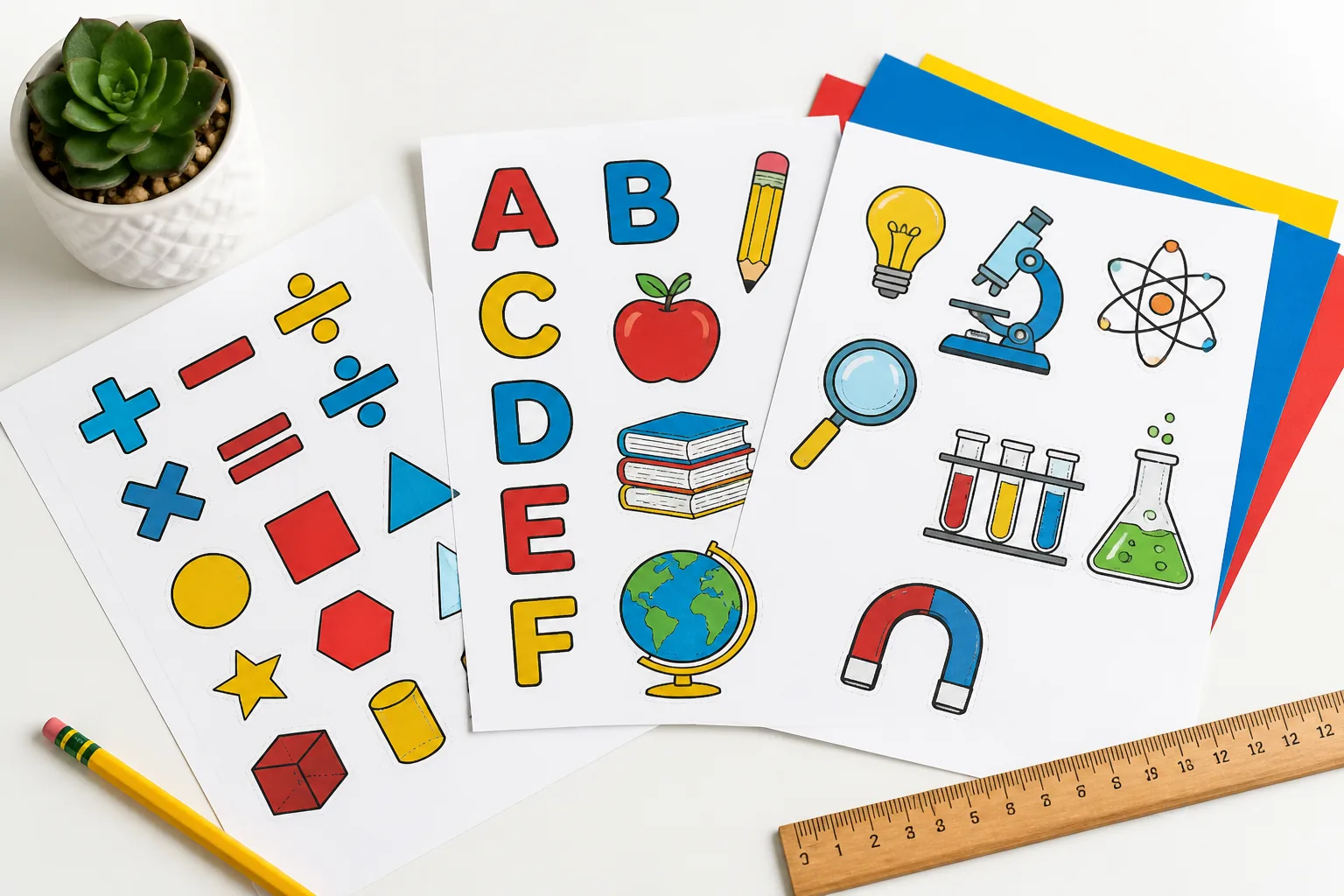
Math manipulatives and visual aids. Base-ten blocks, fraction circles, number lines, geometric shapes, money coins and bills, ten-frame cards. These are used constantly across K-6 and they’re simple enough that a consistent line style holds across a large set. Math clipart buyers are also more specific searchers: “fraction circle clipart” gets better conversion than “math clipart” alone.
Reading and phonics. CVC word characters, vowel-sound visuals, sight word flashcard images, alphabet animals. Elementary teachers making phonics worksheets need these. The key is consistency: a full alphabet set in one style sells better than mixing six different illustration approaches.
Science. Life cycle diagrams (butterfly, frog, plant), parts of a plant/flower, food chain visuals, simple lab equipment, weather icons. These are bought to drop directly into science notebooks and labs.
Seasonal classroom decor. Fall leaves, winter snowflakes, spring garden elements, summer themes (specifically for classroom use: bulletin board headers, worksheet borders), not generic holiday clipart. The search intent is “classroom fall clipart” not just “fall clipart.”
Social-emotional learning (SEL). Feelings/emotions characters, growth mindset visuals, classroom community icons. This segment grew substantially post-2020 and hasn’t been over-served.
Style Rules That Matter
Clean bold outlines, 2–4 point stroke weight, solid or lightly textured fills. Kid-friendly color palettes, saturated but not neon. No gradients that disappear when printed in grayscale. Teachers print a lot.
Test your designs at 2-inch thumbnail size before you finalize anything. If the image reads clearly at that size, it’ll work on a worksheet. If it goes muddy, simplify.
Avoid: photorealistic illustration, heavy shadow effects, thin hairline details. These look good in your listing preview and fall apart at the sizes teachers actually use.
Bundle Structure: What to Include and How to Organize
White Background vs. Transparent
Transparent PNG is the default expectation for any clipart that will be layered into documents. Include it. If you want to also include white-background versions as a bonus, that’s fine (some teachers prefer them for specific use cases), but transparent is the primary deliverable.
File Organization
Deliver a ZIP with a logical folder structure:
- One folder per subject cluster or theme
- File names that describe the image:
fraction-circle-half-transparent.png, notclipart_007.png - A PDF preview sheet showing all images in the set
The preview sheet serves two purposes: it helps teachers quickly scan what they bought, and it makes an excellent second mockup image for your Etsy listing.
Resolution
300 DPI minimum at a minimum of 6 inches wide. This allows printing at letter size without quality loss. Many professional sellers go to 3600px × 3600px per image regardless of subject, which covers every print use case and removes any doubt.
Pricing Strategy
20–30 image bundles: $8–$14 is the standard range. Under $8 starts to signal low quality; over $14 needs clear value justification (larger set, included SVG, commercial license).
Themed packs with commercial license explicitly stated: $12–$18. The commercial license premium is real; TPT sellers budget for it.
Mega-bundles (60+ images, often multiple themes): $22–$40. These work as “growing bundles” where you release sets individually, then offer the mega-bundle at a discount. It’s an effective Etsy store architecture: individual sets rank for specific searches, the mega-bundle captures buyers who found you and want everything.
Don’t start with mega-bundles. Build the individual sets first, get reviews, then bundle.
Licensing: Make It Obvious
This is the single most underused conversion lever in classroom clipart. Teachers buying for TPT will check your licensing terms before purchasing. If they can’t find the answer, they leave.
Put it in the listing description, not just in your shop policies. Use a clear header: “Commercial use included” or “Personal use only.” If you offer both, make personal and commercial separate listings or explain how to upgrade.
For commercial use, specify what’s permitted: use in paid TPT products, Canva templates for sale, client projects. Also note what isn’t: reselling the clipart as-is, redistribution, AI training.
Teachers appreciate directness. They deal with ambiguous fair-use questions constantly in their own work and won’t thank you for adding to it.
Etsy SEO: How Teachers Actually Search
Teachers search differently from other Etsy buyers. They use grade level, subject, and format together:
- “2nd grade math clipart”
- “kindergarten phonics clipart transparent”
- “3rd grade science clipart PNG”
- “elementary classroom decor clipart”
Generic searches like “teacher clipart” are high-volume but also high-competition. The specificity plays in your favor: “life cycle clipart transparent background” has lower volume but much higher purchase intent and lower competition.
Use all 13 Etsy tags. Prioritize: grade level + subject, format (transparent PNG, 300 DPI), and use case (worksheet clipart, TPT clipart, Google Slides clipart). See Etsy SEO for a full keyword strategy framework.
Your listing titles should front-load the specific subject: “Fraction Clipart Bundle – Transparent PNG – Math Manipulatives for Teachers” outperforms “Teacher Math Clipart Set for Classroom.”
Creating Consistent, Expandable Sets
The sellers doing best in this niche aren’t releasing one-off packs. They’re building subject libraries. Start with a core subject (fractions, phonics, seasons), release it as a standalone, then expand:
- Fractions set 1 → Fractions set 2 → Fractions mega-bundle
- Phonics CVC → Long vowels → Sight words → Reading clipart bundle
This architecture builds internal Etsy linking (buyers who viewed your fraction set also see your other math clipart), and it creates a catalog that grows in authority over time.
Each new release also reactivates your shop in search rankings, since Etsy rewards recent activity.
Generating Classroom Clipart at Scale
The style consistency problem is the hardest part of growing a clipart catalog. Maintaining the same line weight, color palette, and illustration approach across 200+ images manually is time-consuming and error-prone.
Elistit’s Clipart Bundle Creator generates 10–25 transparent PNG images per theme in a consistent style, useful for seeding a catalog with coherent sets before refining by hand. Pair generated outputs with style guidelines specific to your brand, and you can iterate faster without losing visual consistency.
More on structuring the production process: Etsy Clipart Bundle Creation Guide and Print-Ready File Specifications.
The Sub-Niches With Room to Grow
Most sellers pile into general elementary subjects. These areas are under-served as of 2026:
STEM and coding concepts. Algorithms, computational thinking visuals, binary/logic diagrams, robotics icons. The curriculum adoption is outpacing clipart supply.
Financial literacy. Budget worksheets, banking concepts, saving vs. spending visuals. Growing as a subject area; almost no dedicated clipart sellers.
ESL/ELL vocabulary sets. Dual-language labels, vocabulary image cards for English learners. A large teacher market that buys consistently.
Gifted/advanced curriculum. Abstract thinking, Bloom’s Taxonomy visuals, logic puzzle illustrations. Smaller audience but very deliberate buyers.
Cultural representation and world geography. Accurate, respectful illustrations of world cultures, traditional clothing, landmarks. High demand, chronically under-served by current clipart supply.
Pick one. Build 5–10 packs. See whether the search volume and conversion rates match before expanding.
Quick questions
Quickly answered.
Q.01What types of classroom clipart sell best on Etsy?
Subject-specific sets tied to curriculum standards sell best: math manipulatives, phonics characters, science diagrams, and seasonal classroom decor. Clean, bold-outline styles that print well at small sizes perform strongest because teachers drop these into worksheets and presentations.
Q.02How many images should a classroom clipart bundle have?
20–30 images per bundle is the standard that converts. Fewer feels thin for the price; more starts to look like low-effort filler. If you're doing a themed set (e.g., fraction manipulatives), 15–20 tightly relevant images outperforms 40 loosely related ones.
Q.03What file format do teachers expect for clipart (PNG vs SVG)?
PNG at 300 DPI with transparent backgrounds is the baseline expectation. SVG is a nice-to-have that justifies a higher price, but most teachers use Google Slides, Canva, or Microsoft Office, and they need PNG. Always lead with PNG; add SVG as a bonus if you have it.
Q.04Can I sell clipart that teachers use in commercial products?
You can, but you must say so explicitly in your listing. Many teachers sell on Teachers Pay Teachers (TPT), which requires them to hold a commercial license for every asset they use. If your listing doesn't mention commercial use, teachers building TPT resources will skip it or message you, both of which hurt conversion.
Q.05What subjects and themes have the least competition in classroom clipart?
Specialty subjects are under-served: STEM/coding concepts, financial literacy for kids, world geography with accurate cultural representation, gifted/advanced curriculum visuals, and ESL/ELL classroom vocabulary. General animals and alphabet sets are saturated.
Keep going.
Botanical Wall Art for Etsy: What Sells, What's Oversaturated, and How to Stand Out
Botanical is one of Etsy's most competitive niches. How to find the undersaturated sub-niches and create botanical prints that actually rank.
Boho Wall Art for Etsy: Designs That Sell in 2026
Complete guide to creating profitable boho wall art for Etsy. Design principles, trending aesthetics, pricing strategy, and how to batch-create variations.
Celestial Wall Art for Etsy: Designs, Trends, and What Sells in 2026
Moon phases, star maps, zodiac prints: what celestial buyers want on Etsy and how to create high-converting celestial wall art listings.
Coastal Grandmother Wall Art for Etsy: The Aesthetic That Keeps Selling
Coastal grandmother is relaxed, timeless, and has buyers with disposable income. What the aesthetic wants and how to create prints that fit it.