Botanical Wall Art for Etsy: What Sells, What's Oversaturated, and How to Stand Out
Botanical is one of Etsy's most competitive niches. How to find the undersaturated sub-niches and create botanical prints that actually rank.
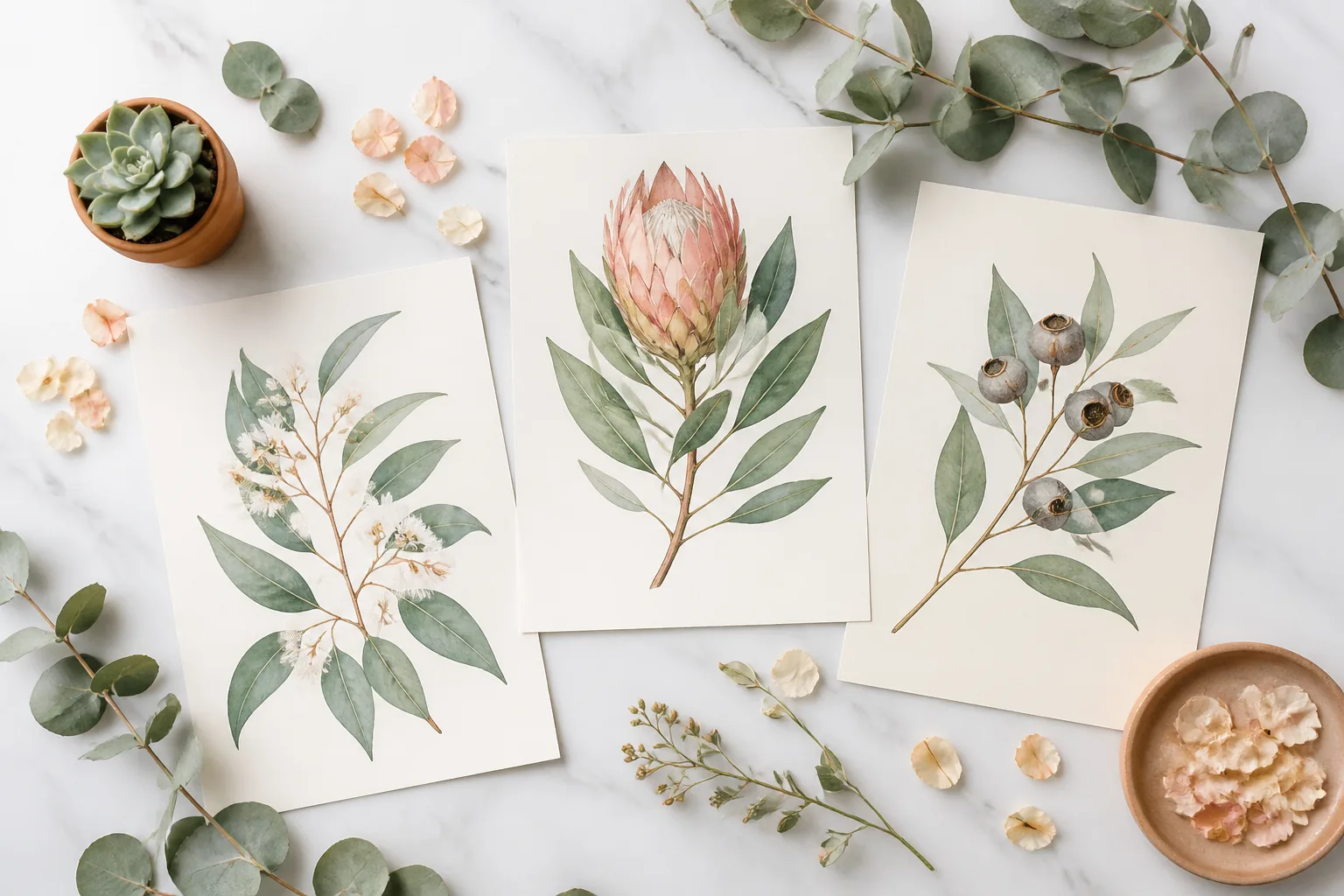
Botanical wall art is Etsy’s most competitive digital art niche by listing count. Search “botanical print” and you’ll find hundreds of thousands of results. It’s also a niche where buyers spend money consistently: year-round, broad demographic, strong gift-buying component. The saturation is real, but so is the market.
The shops that fail in botanical go in with a generic product: a watercolour rose on a white background, or a loose floral illustration with no clear sub-niche or buyer in mind. The shops that build sustainable businesses find a specific corner of botanical that’s underserved, create a cohesive series, and own that corner on Etsy search.
Botanical buyers are interior decorators at heart. They’re buying to fill a specific wall, in a specific room, with a specific palette. They’re often purchasing sets rather than singles. They have high standards for print quality because they’re paying to put something on their wall. This is a niche where bad mockup photography and low-resolution files generate refunds, and good photography and a cohesive shop aesthetic generate repeat purchases.
What’s Oversaturated (and What Isn’t)
Oversaturated:
- Generic rose watercolour prints on white backgrounds
- Loose peonies and hydrangeas in pastel palettes
- Tropical leaf prints (monstera, banana leaf, palm)
- Basic green plant silhouettes on white or cream
These subjects aren’t dead, but the listing count means you’ll need exceptional visual quality and strong SEO just to get indexed in a visible position. If this is where you’re starting, you’re competing against established shops with hundreds of reviews.
Undersaturated with real buyer demand:
Regional wildflowers: Pacific Northwest wildflowers, Scottish or Irish meadow flowers, Australian native flora (banksia, grevillea, wattle), South African fynbos. Buyers who grew up with or live near these plants actively search for them. The competition is thin because sellers default to European species.
Edible plant illustrations: Botanical-style vegetable charts (heirloom tomato varieties, bean species, brassica family), fruit studies (fig cross-section, pomegranate, quince), kitchen herb collections. These cross over with the culinary enthusiast buyer and sell into kitchen and dining room decor specifically. Much lower saturation than decorative flowers.
Carnivorous plants: Venus flytraps, sundews, pitcher plants, bladderworts. There’s a devoted buyer base (people who grow carnivorous plants or who love their unusual beauty) and the listing count is surprisingly low for the demand level.
Scientific and historical style illustration: Victorian herbarium style with proper labels, binomial nomenclature, and aged paper backgrounds. This niche caters to buyers who want something that looks like it came from a 19th-century botanical survey. The illustration style is harder to execute (or prompt precisely), which keeps competition lower.
Fern and moss studies: Individual fern species rendered in fine detail, moss and lichen close-up studies. Interior designers use these for bathroom and bedroom decor. The buyer looking for “Japanese forest fern print” has very specific intent and finds almost no quality listings when they search.
What Sells Within the Established Sub-niches
Even in the crowded watercolour floral space, certain approaches consistently outperform:
Labeled botanical charts. A plate with 6–9 specimens of the same plant family, each with a handwritten or engraved label, outsells individual plant portraits. The “chart” format reads as more premium and educational. A chamomile family chart outperforms a single chamomile illustration.
Matching sets with explicit pairing. A set of 3–4 botanical prints in the same palette, same paper background, same framing, same level of detail, listed as a bundle, outperforms individual listings by average order value and often by conversion rate. Buyers who are decorating a wall don’t want to hunt for three things that match.
Kitchen and room-specific botanical art. “Herb print for kitchen,” “bathroom botanical prints,” “bedroom botanical set” are room-specific searches with buyer intent. A single product positioned correctly (“these are for your kitchen, here’s how they look on a shiplap wall”) converts better than the same product positioned generically.
Color palettes that convert:
- Aged parchment + sepia + warm ochre: Victorian herbarium buyers
- Sage green + cream + dusty rose: cottagecore and slow-living buyers
- Clean white + forest green + black lettering: modern farmhouse and Scandinavian buyers
- Terracotta + warm olive + cream: earthy boho buyers
Pick one palette lane and stay in it across a series. Botanical shops with mixed palettes across their listing grid look incoherent and lose the buyers who are making a committed decorating purchase.
Common Mistakes
Using the same subjects that appear in the first 3 rows of Etsy search results. Before building a botanical series, search Etsy for the subject you’re planning and look at what’s already there. If the first page is dense with quality listings from established sellers, find a related but less crowded angle.
Botanical art with no botanical accuracy. Buyers who specifically seek botanical illustration (as opposed to decorative floral art) often have some knowledge of plants. A rose that doesn’t look like a rose, or a label that’s misspelled, generates negative reviews. AI-generated botanical art in particular tends to produce anatomically improbable plants; check outputs carefully.
Listing individual prints when buyers want sets. In botanical more than most niches, the set is the product. A buyer decorating a dining room wants 4 coordinated fruit studies, not one apple illustration. Build and list sets, with individual prints as secondary listings.
Dark backgrounds for botanical art. Unless you’re doing a very specific “botanical on dark paper” sub-niche, botanical buyers expect natural-toned or white backgrounds. Dark navy botanical art can work, but it’s a narrower market.
Technical Specs for Botanical Prints
Botanical buyers have higher-than-average expectations for print quality because the style relies on fine detail: thin linework, delicate color gradients, small text labels.
Resolution: 300 DPI minimum. For detailed Victorian herbarium style with small text labels, test your export at 100% view on screen before publishing; small text that looks fine on screen can be illegible when printed. See the 300 DPI guide for correct export settings.
Sizes: 5×7, 8×10, 11×14, A4. For chart formats (multi-specimen on one sheet), 8×10 and A4 are the most practical for home printing. Include 16×20 for buyers who want a statement piece for a dining room or hallway.
Ratios: Botanical art is predominantly portrait/vertical orientation. Square formats have limited demand in this niche. For a gallery wall set of 3, all three should be the same size and orientation; buyers need to hang them in a row. The wall art ratio guide covers how to build consistent artboard templates for multiple sizes.
File format: High-quality JPEG for most botanical art. If you have designs with extensive small text (labels, Latin names), export as PDF as well; PDF preserves text sharpness better than JPEG at small point sizes.
Etsy SEO for the Botanical Niche
Title pattern:
[Specific Plant/Subject] Botanical Print | [Style Descriptor] [Format] | Digital Download | [Room context]
Example: Heirloom Tomato Botanical Print | Vintage Vegetable Chart Printable | Kitchen Wall Art Digital Download | 8x10 A4
The subject should be as specific as possible. “Botanical print” alone is unindexable noise. “Carnivorous plant botanical chart” is a keyword cluster with real search volume and very low competition.
Tags: Use 13 tags strategically. Lead with the specific subject (“carnivorous plant art,” “pitcher plant print,” “Venus flytrap botanical”), then include style (“botanical illustration,” “vintage herbarium print”), then room application (“bathroom wall art,” “kitchen print”), then size (“8x10 printable,” “A4 botanical print”). Broad tags like “nature art” and “plant print” use up tag slots without driving targeted traffic.
Category selection matters: List botanical art under “Art & Collectibles > Prints > Digital Prints” rather than “Home & Living.” Buyers browsing the art category are in purchase mindset; search traffic finds you regardless of category.
Seasonal timing: Spring and early summer are botanical niche peaks; buyers are gardening, decorating, and in a plant-positive mindset. Upload new listings in February to be indexed before the March–May peak. The Etsy SEO guide covers indexing timelines and how to estimate when a new listing will start ranking.
Creating Botanical Art Efficiently
The challenge with botanical illustration is production time. A detailed Victorian herbarium plate with 8 labeled specimens, rendered carefully by hand, takes a skilled illustrator hours. A cohesive shop of 30 botanical listings in the same style requires months of work.
This is where AI-assisted generation changes the math. Prompts structured around a specific style (“Victorian herbarium botanical illustration, chamomile specimen, sepia and sage palette, aged parchment background, copperplate lettering labels, 300 DPI”) produce output that, with proper upscaling and file preparation, meets print quality standards. The consistency question (do all 30 listings look like they belong together?) is solved by keeping the style prompt tightly defined across a series.
Elistit’s wall art generator is built for exactly this workflow: describe a botanical design, receive print-ready files at 300 DPI in standard ratios in under 15 minutes. For a seller building a 20-listing regional wildflower series, this makes the project feasible in a week rather than months.
The caveat: botanical accuracy matters in this niche. Check AI outputs against real botanical reference images. A plant that looks generically “leaf-like” rather than specifically identifiable is a missed opportunity and a potential negative review from a buyer who knows their plants.
Finding Your Corner of the Niche
The botanical niche has room for new sellers who identify a specific corner and commit to it. A 20-listing shop focused entirely on Australian native botanical illustration, done in a consistent vintage scientific style, will outperform a 100-listing shop of mixed botanical subjects with no coherent identity.
Before you build, spend an hour searching Etsy for the subjects you’re considering. Look at listing view counts (visible on some listings), favorite counts, and how many reviews the top sellers have. A subject with a strong #1 seller (500+ reviews) but weak competitors in positions 5–20 is an opportunity: the demand is proven, and the field is open for a strong challenger.
The botanical niche rewards specificity, consistency, and patience. It’s not a quick-start niche. But it’s a real business.
Related aesthetics
- Boho Wall Art: the organic, earthy aesthetic that shares botanical buyers.
- Cottagecore Wall Art: nature-led prints for the same nostalgic, plant-loving shopper.
Quick questions
Quickly answered.
Q.01Which botanical sub-niches are still undersaturated on Etsy in 2026?
Regional wildflower collections (Pacific Northwest, Scottish Highlands, Australian native flora) are less crowded than generic European wildflowers. Edible plant illustrations (labeled fruit botanical charts, vegetable garden art) have solid demand and fewer quality listings than the decorative flower categories. Carnivorous plant art (Venus flytraps, pitcher plants, sundews) has a devoted buyer base and very few quality sellers. Fern and moss studies, particularly scientific-illustration style, have growing demand from interior decorators who want something different from the standard floral print.
Q.02Which sells better: botanical illustration or botanical watercolour?
Botanical illustration (fine line art with flat or minimal color fill, in the scientific herbarium style) converts better in professional and home office settings and has lower saturation on Etsy. Botanical watercolour is the higher-volume style but competes with far more listings. If you're starting a new shop, botanical illustration is the harder style to produce but the easier market to enter. Watercolour sells, but you need strong visual differentiation to stand out in search results where the thumbnail grid is dense with similar-looking art.
Q.03What color palettes work best for botanical wall art on Etsy?
Aged parchment and sepia for Victorian herbarium style. Sage green, dusty rose, and cream for cottagecore crossover buyers. Cool botanical greens with white backgrounds for modern interiors. Terracotta and warm olive for earthy boho buyers. The weakest palette choice for this niche is bright, vivid color; buyers seeking bold color go to tropical or abstract art categories. Botanical buyers want naturalistic, muted, or period-appropriate color treatments.
Q.04What are the most popular sizes for botanical prints?
5x7 and 8x10 for individual prints, 11x14 for botanicals displayed as a feature piece. Gallery wall sets of 3 or 6 in matching sizes are very popular; a buyer decorating a hallway wants 3 matching botanical prints in the same size, not one large print. A4 is essential for UK and European buyers. The most successful botanical shops offer a 'set of 3' bundle in a single listing, which has higher average order value and often outperforms individual listings in search because it solves the buyer's complete decorating problem.
Q.05Can I sell AI-generated botanical art on Etsy?
Yes, with disclosure. Etsy requires sellers to disclose AI tool use in listings. In the botanical niche specifically, quality of illustration matters to buyers; detailed, botanically-accurate plants outperform generic 'pretty flower' AI outputs. The advantage of AI tools in this niche is speed of producing cohesive series: if your style prompt is well-defined (specific linework, palette, paper texture), you can generate a 20-plant collection that looks like a consistent shop. The disadvantage is that the most common AI botanical outputs are already oversaturated, so you need style specificity to generate something that looks distinctive.
Keep going.
Boho Wall Art for Etsy: Designs That Sell in 2026
Complete guide to creating profitable boho wall art for Etsy. Design principles, trending aesthetics, pricing strategy, and how to batch-create variations.
Celestial Wall Art for Etsy: Designs, Trends, and What Sells in 2026
Moon phases, star maps, zodiac prints: what celestial buyers want on Etsy and how to create high-converting celestial wall art listings.
Classroom Clipart for Etsy: The Niche, What Teachers Buy, and How to Create Bundles That Sell
Classroom clipart is one of Etsy's steadiest niches. What teachers search for, how to price and structure bundles, and what makes a set convert.
Coastal Grandmother Wall Art for Etsy: The Aesthetic That Keeps Selling
Coastal grandmother is relaxed, timeless, and has buyers with disposable income. What the aesthetic wants and how to create prints that fit it.