Cottagecore Wall Art for Etsy: Designs That Sell and How to Create Them
What cottagecore buyers want, which designs sell, pricing ranges, and how to create print-ready cottagecore wall art for Etsy in 2026.
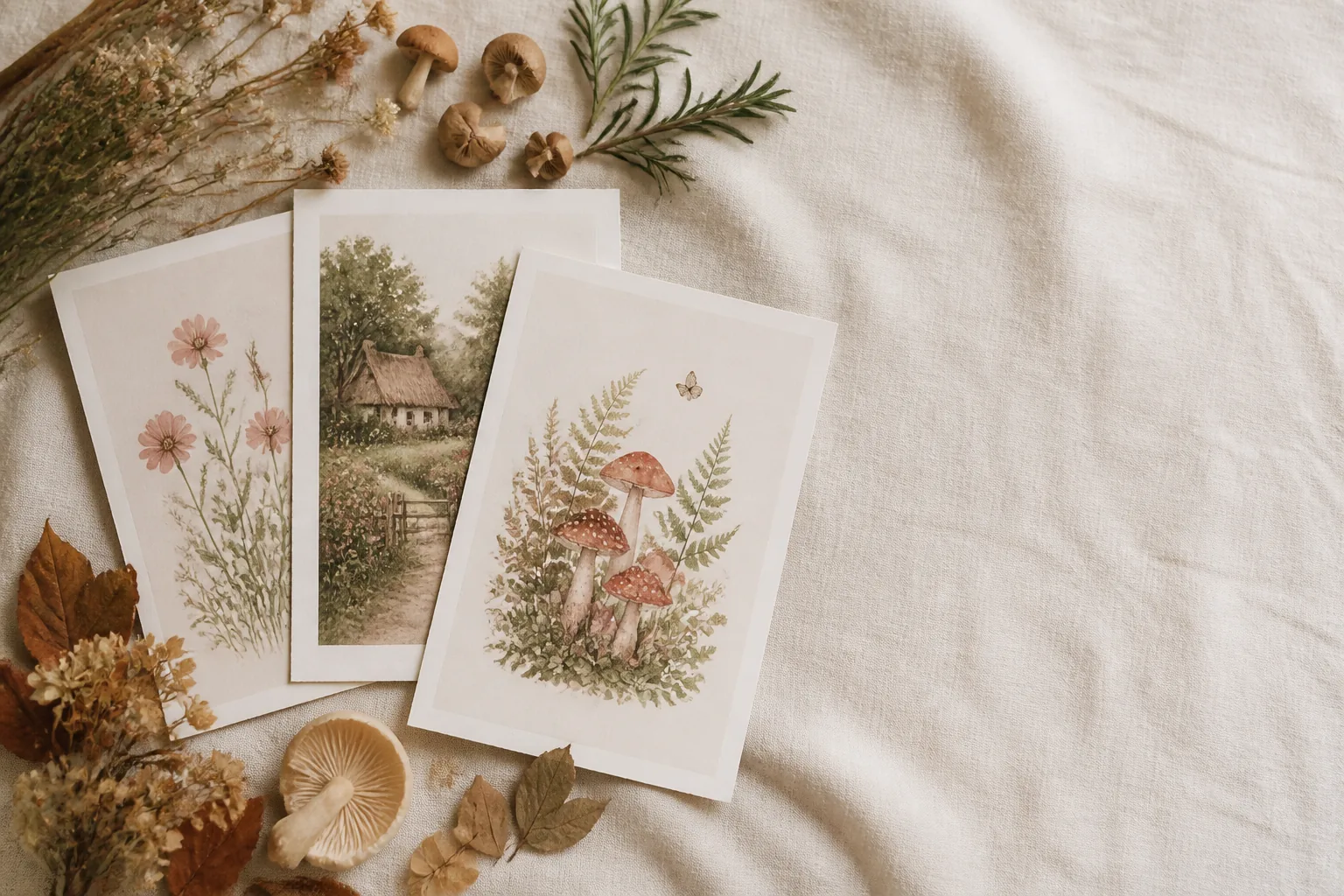
Cottagecore as an aesthetic peaked in 2020–2021 but its buyer base didn’t evaporate. It settled into a stable, year-round niche of buyers who are genuinely decorating their homes in this style, not just trend-chasing. The Etsy search volume for cottagecore-adjacent terms (botanical print, wildflower art, cottagecore decor) has plateaued rather than collapsed. What changed is the buyer’s standards: they can now spot generic AI-generated mushroom prints from across the shop page, and they skip them.
The buyers are primarily women 25–45 decorating rentals, cottages, or dedicated ‘cosy’ rooms. They shop in sets, not singles. They have a specific palette in mind before they open Etsy. If your print doesn’t fit that palette in the thumbnail, you don’t get the click.
What Sells in the Cottagecore Niche
Specific botanicals over generic flowers. Chamomile, lavender, wild rose, sweet pea, fern fronds, cow parsley, foxglove: named, botanically-recognisable plants outperform “flower illustration” on search and on conversion. A buyer searching “lavender printable art” has buying intent; a buyer scrolling “flower art” is browsing.
Mushrooms and fungi. This sub-niche has stayed durable since 2020. Fly agaric (the red and white spotted mushroom), chanterelles, oyster mushrooms, and morels all have individual search demand. Botanical-style mushroom charts (a sheet of 6–9 labeled fungi varieties in a scientific illustration style) are a consistent top seller across multiple shops.
Forest animals with botanical framing. A fox surrounded by fern fronds, a rabbit in a wildflower meadow, a deer in an autumn forest. The animal is the focal point, but the botanical surround is what makes it cottagecore rather than generic nursery art. Without the botanical context, these become children’s prints, which is a different buyer.
Apothecary and herb illustrations. Labeled herb charts, “kitchen herb” collections, mortar-and-pestle compositions. These cross over with cottagecore buyers who are also into slow living, herbalism, or traditional crafts. The “dried herb bunch” style (bundles tied with twine, rendered in soft watercolour) has stayed popular for three years without obvious saturation.
Seasonal sets. A four-print autumn set (mushroom, blackberry, rosehip, maple leaf) in matching palette and frame style will outsell four individual prints at the same total price. Build seasonally and offer the set as a bundle.
Color palettes that work: sage green, dusty rose, warm cream, terracotta, burnt sienna, soft ochre, muted lavender, moss green. Backgrounds should be cream or aged paper, not white. Palette consistency across a set is more important than any individual print.
What Doesn’t Sell / Common Mistakes
Bright, saturated colors. A bright orange mushroom or a vivid blue floral reads as children’s art or boho, not cottagecore. If your palette has any color you’d describe as “bright” or “vibrant,” it’s wrong for this niche.
Generic “nature” scenes without specificity. “Floral art print” is too broad. “Cottagecore mushroom botanical chart printable” targets the buyer precisely. Generic subjects compete in a much wider, more competitive pool.
Minimalist or Scandinavian styling applied to cottagecore subjects. A foxglove rendered with geometric linework and white negative space reads Japandi, not cottagecore. The illustrative style matters as much as the subject.
Seasonal designs uploaded late. Autumn mushroom sets uploaded in October are 4–6 weeks too late for Etsy’s indexing. Upload seasonal designs in August for autumn and January for spring to give listings time to build views before peak.
Sets with mismatched palettes. If you sell a 4-print set and two prints have warm beige tones while two have cool gray-green tones, buyers won’t buy the set because it won’t hang cohesively. Test the full set at thumbnail size before publishing.
Technical Specs for This Niche
Cottagecore buyers skew toward home printing rather than sending files to print shops. That means your files need to work at the sizes a home printer handles.
Recommended sizes: 5×7 in, 8×10 in, A4 (8.27×11.69 in), 11×14 in. Square formats (8×8, 10×10) for gallery walls.
Resolution: 300 DPI minimum. See the 300 DPI guide for how to check and export correctly. A blurry print on a buyer’s living room wall generates a refund request.
File formats: JPEG is standard for wall art prints (buyers don’t need to edit them). Include a PDF for any design with a white or near-white background, since PDF preserves the border print behavior on home printers better than JPEG.
Color space: sRGB. Don’t submit CMYK files for digital downloads. Buyers can’t manage color profiles on home printers, and CMYK files look washed out on screen.
Ratios: Offer at minimum three ratios per design: 5:7 vertical, 4:5 vertical, and A4. A ratio bundle significantly reduces buyer questions about sizing. The wall art ratio guide covers how to set up your artboard correctly for each standard format.
Etsy SEO for the Cottagecore Niche
Title pattern that works:
[Subject] Printable Wall Art | Cottagecore [Descriptor] Print | [Style] Digital Download | [Size reference]
Example: Chamomile Botanical Printable Wall Art | Cottagecore Wildflower Print | Vintage Illustration Digital Download | 5x7 8x10 A4
Best tags: Prioritize long-tail over broad. “Cottagecore wall art” and “botanical printable art” are high volume but competitive. Pair them with specific tags: “chamomile print,” “mushroom chart printable,” “wildflower illustration,” “vintage botanical art,” “herbarium print.” Include size tags (“8x10 printable,” “A4 printable art”) because buyers often filter by size.
Don’t keyword-stuff the description. Use the first 2–3 sentences of the description for conversion (what the buyer gets, what it looks like, what sizes are included), then add keywords naturally in the body. Etsy reads the full description but buyers read the first paragraph.
Listing photos: Show the print in a styled interior first. A cream wall, a rattan frame, some dried flowers nearby. This is the thumbnail that gets the click. The second photo should show the files/sizes included. Third: flat lay with matching prints from your shop. Mockup quality matters more in this niche than most. See the Etsy SEO guide for how to structure your listing images to maximize click-through.
Creating Cottagecore Art at Scale
The bottleneck in this niche isn’t ideas. It’s production. You can list a chamomile botanical chart, a lavender bunch, a wild rose illustration, a fern frond study, a mushroom collection, and be 5 listings into a cohesive shop in a day. The problem is creating matching illustrations across all of them: same linework weight, same color palette, same paper texture, same overall feel.
If you’re creating manually, this takes 10–15 hours per cohesive set. Tools like Elistit’s wall art generator let you describe a specific design (e.g. “botanical illustration of wild chamomile on aged paper, sage and cream palette, Victorian herbarium style”) and generate print-ready files at 300 DPI across all standard ratios in under 15 minutes. The consistency across a set stays high because you’re using the same style prompt across designs, which means the 4-print set problem (mismatched palettes) is easier to control.
The practical value for cottagecore sellers is speed-to-cohesive-set: you can test whether a mushroom chart set outperforms a wildflower set without investing 30 hours of illustration time first.
Building a Cohesive Cottagecore Shop
The strongest cottagecore shops on Etsy have a recognisable visual identity: you can tell from the thumbnail grid that every listing belongs to the same shop. Buyers who buy one print and love it will come back for others in the same series.
Build in series from day one. Launch a “wildflower collection,” a “forest forage collection,” an “apothecary herbs collection.” Give each series a consistent title prefix so buyers can find the rest of the set. Cross-link within your shop, since Etsy’s algorithm rewards shops where buyers view multiple listings per session.
Don’t launch 40 individual unrelated prints. Launch 4 coordinated series of 6–8 designs and price each series as a bundle option. Buyers who discover the bundle will pay $12–$16 for what would otherwise be 4 × $4 individual sales, and they’ll be happier with the product because they have a wall’s worth of cohesive art.
The niche has room. The buyers are real. What separates the shops making consistent sales from the ones stalled at 12 views a month is specificity, palette discipline, and setting.
Related aesthetics
- Boho Wall Art: the organic, earthy cousin with overlapping buyers.
- Botanical Wall Art: botanical prints that fit the same nature-led shop.
Quick questions
Quickly answered.
Q.01What subjects sell best for cottagecore wall art on Etsy?
Botanical illustration, mushrooms, wildflowers, bees, cottages, forest animals (foxes, rabbits, deer), and botanical apothecary imagery consistently outsell generic 'nature' scenes. Specific plants (chamomile, lavender, wild roses, ferns) outperform vague 'flower' prints. The more botanical-accurate the illustration, the better it tends to convert with cottagecore buyers.
Q.02What's a realistic price range for cottagecore printable wall art?
Single prints sell between $3–$6. Sets of 3–4 coordinated prints in the same palette and style sell for $8–$14 and convert better because buyers are decorating a wall, not hunting for one accent. Bundles of 6+ at $12–$18 exist but require very cohesive styling. Price above $10 for singles only if the illustration quality is exceptional or the subject is highly specific (e.g. a named wildflower variety).
Q.03Are there seasonal demand spikes for cottagecore prints?
Spring (March–May) is the strongest season, when buyers are redecorating and the aesthetic aligns with blooming flora. A secondary spike runs October–November as the 'cosy autumn cottage' mood takes over and buyers want mushrooms, dried botanicals, and harvest imagery. Summer is steady but not a spike. December is weaker than other home decor categories because cottagecore buyers don't usually buy Christmas-specific art.
Q.04What are the cottagecore style rules I need to follow to sell in this niche?
Muted, natural palettes: sage green, dusty rose, cream, warm beige, terracotta, soft ochre. No bright saturated colors. Typography (if any) should be loose handwritten script or aged serif, never bold modern sans-serif. Backgrounds lean cream or aged paper rather than white. Linework illustrations with gentle watercolour wash outperform flat vector and hard-edged digital art in this niche.
Q.05What sizes do cottagecore buyers actually download?
5x7 and 8x10 are the most requested, followed by A4 (for UK/European buyers). Square formats (8x8, 12x12) perform well for gallery wall sets. Offer a ratio pack covering at minimum 4:5 vertical, 5:7 vertical, and A4. Buyers who are building gallery walls need multiple sizes in the same style, so offering a matching set in 3 sizes per design significantly increases average order value.
Keep going.
Botanical Wall Art for Etsy: What Sells, What's Oversaturated, and How to Stand Out
Botanical is one of Etsy's most competitive niches. How to find the undersaturated sub-niches and create botanical prints that actually rank.
Boho Wall Art for Etsy: Designs That Sell in 2026
Complete guide to creating profitable boho wall art for Etsy. Design principles, trending aesthetics, pricing strategy, and how to batch-create variations.
Celestial Wall Art for Etsy: Designs, Trends, and What Sells in 2026
Moon phases, star maps, zodiac prints: what celestial buyers want on Etsy and how to create high-converting celestial wall art listings.
Classroom Clipart for Etsy: The Niche, What Teachers Buy, and How to Create Bundles That Sell
Classroom clipart is one of Etsy's steadiest niches. What teachers search for, how to price and structure bundles, and what makes a set convert.