Psychological Pricing for Etsy Digital Products: Why $7.99 Beats $8.00
Small framing choices change how buyers perceive price. On zero-marginal-cost digital products, the right tactics add pure margin. What actually works on Etsy.
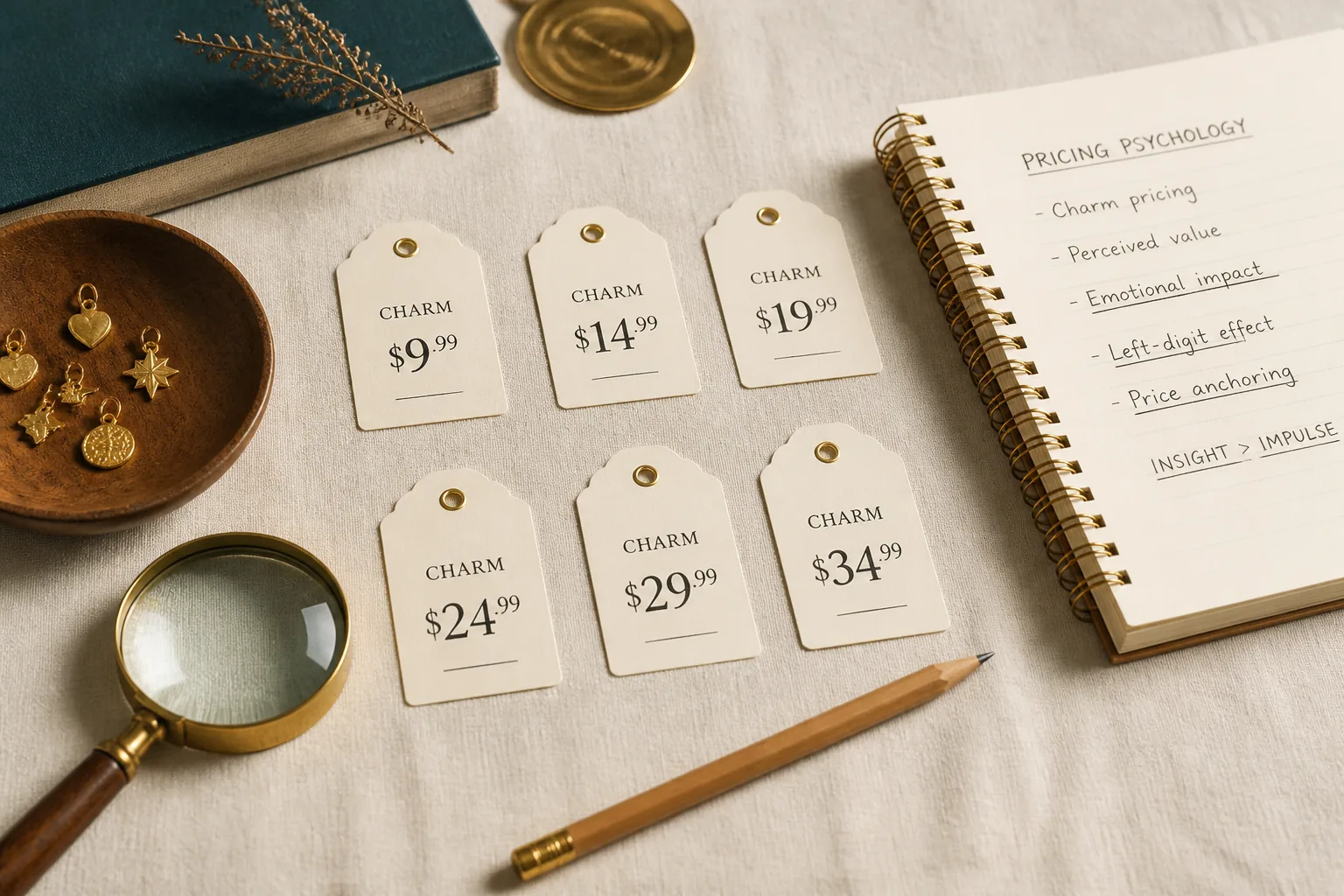
Charm Pricing and the Left-Digit Effect
The most reliable pricing tactic in digital commerce is also the simplest: end prices in .99 (or .95) rather than rounding up.
This works because of the left-digit effect. Buyers don’t read prices as whole numbers; they process them left to right and weight the first digit most heavily. So $7.99 reads as “seven-something” and gets filed mentally near $7, while $8.00 reads as “eight dollars” and sits in the eight-dollar tier. The actual difference is one cent. The perceived difference is a whole price bracket.
On a physical product with material costs, surrendering a penny per sale across thousands of units adds up. On a digital download, that penny is the only thing you give up: no per-unit cost, no inventory, no shipping. You trade one cent for a measurable lift in perceived affordability. That’s about as close to free margin as pricing gets.
Default to charm endings across your impulse-band products: $4.99, $6.99, $9.99, $12.99. The exception, covered below, is when you deliberately want the price to signal premium.
Price Anchoring with Tiered Options
A price means nothing in isolation; it only means something relative to other prices the buyer can see. Anchoring is the deliberate placement of a higher reference price so your target price looks like a deal.
On Etsy, you build anchors with tiers: a single item, a small set, and a large bundle. Presented together, the bundle’s per-item math looks cheap against the single, and buyers shift toward the better-value option.
This is also where the decoy effect lives. Consider three tiers:
- 1 print: $6
- 3 prints: $14
- 6 prints: $16
The 3-print tier is the decoy. Once a buyer sees that 6 prints cost only $2 more than 3, the 6-print bundle becomes the obvious choice (the decoy makes the top tier look like an obvious win). The middle option doesn’t need to sell well; its job is to make the bundle you actually want to push look irresistible.
The high anchor doesn’t even have to sell. A premium $40 mega-set you rarely move still earns its keep by making your $18 set look modest by comparison.
”Compare At” Framing Raises Single-Item Value
A set price quietly raises the perceived value of every single item inside it.
When a listing shows “Set of 6, $14.99 (singles: $36),” two things happen. The bundle looks like a steal, and more subtly, each individual print now feels like it’s “worth $6.” You’ve established a reference value for the singles even for buyers who only ever wanted one.
Use this deliberately. Show the a-la-carte total next to the bundle price. The contrast does the persuading: the buyer sees the savings, internalizes the per-item worth, and is more likely to trade up to the set. The framing costs nothing and works on zero-marginal-cost goods especially well, because you’re not actually discounting anything you paid for.
The Round-Number Exception
Charm pricing is the default, but it isn’t universal. Round numbers signal premium.
A price of $14.99 says “deal.” A price of $15 (or $25, or $40) says “quality, confidence, no gimmick.” For products you’re positioning at the top of your range (large gallery wall sets, extended commercial-license mega-bundles, anything where the perception of craft is the selling point), a clean round number reinforces the premium frame that a .99 ending would undercut.
The rule of thumb: charm-price impulse items, round-price premium items. If you want the buyer to feel they’re getting a bargain, end in .99. If you want the price itself to communicate that this is the high-end option, go round. Mixing both across a shop is fine and even useful: the round-priced premium tier becomes a natural anchor for the charm-priced everyday items.
Bundle Framing with Price-Per-Item
Buyers respond to the unit they care about, and for bundles that unit is the per-item price.
Whenever you sell a set, surface the per-item math for them: “30 clipart elements, $14.99 (just 50¢ each).” Don’t make the buyer do the division. Do it for them and put the small number where they’ll see it. A $14.99 bundle feels expensive; “50¢ each” feels generous. Same price, reframed around the number that triggers the value judgment.
This pairs naturally with anchoring. Show the per-item price and the compare-at total and you’ve stacked two framing wins: the bundle looks cheap per unit and cheap versus buying singles. On digital products, where the marginal cost of adding items to a bundle is zero, you can afford to make these per-item numbers genuinely low.
Discount Psychology: % Off vs $ Off
Discounts work, but the framing should match the price so the number on the badge sounds as large as possible.
The rule of 100 is a useful heuristic. Below about $100 (which is nearly all digital products) percentage discounts usually look bigger. On a $7.99 item, “40% off” sounds far more generous than “$3.20 off.” Above $100, or on higher-priced bundles, a dollar amount can feel more concrete: “$10 off” on a $35 bundle can read as more substantial than “28% off.”
So for everyday digital items, frame sales as percentages. For your premium bundles, test dollar-off framing. The underlying discount can be identical; you’re choosing the presentation that makes the saving sound largest at that price point.
The Zero-Marginal-Cost Advantage
All of this matters more for digital products than for almost any other category: every framing win is pure margin.
A physical seller who nudges a price up a dollar still has material, packaging, and shipping costs eating into the gain. A digital seller has none of that. When a charm ending, a sharper anchor, or a per-item frame lifts conversions or order value, almost the entire upside flows to profit, because there’s no per-unit cost to subtract. Digital downloads already run roughly 80–88% margin (non-Offsite) or 68–73% when Offsite Ads attribute the sale; pricing psychology pushes you toward the top of those bands rather than the bottom.
This is also why it’s worth knowing your real net before you reach for these tactics. Run your price through the Etsy Pricing Calculator to see exactly what you keep after the $0.20 listing fee, 6.5% transaction fee, ~3% + $0.25 processing, and Offsite Ads. Then layer the psychology on top of a number you’ve already confirmed is healthy.
What NOT to Do
The biggest self-inflicted pricing wound on Etsy is the permanent sale.
Run a “40% off” promotion constantly and you teach buyers two things: the real price is the sale price, and there’s no reason to ever buy at full price. You’ve trained your own market to wait. The discount stops being a nudge and becomes the baseline, and now you’re permanently earning less on a price you set artificially high to make the “sale” look good.
Use sales as genuine events (a launch, a seasonal push, a clearly time-boxed promotion), not as a default state. The same goes for racing competitors to the bottom: undercutting on price erodes the margin advantage that makes digital products worth selling in the first place.
The healthier move is to compete on perceived value (better framing, smarter bundles, clearer licensing) while holding honest prices. To turn that pricing confidence into copy that converts, see Etsy descriptions that convert, and for what to actually build and price next, browse Etsy digital product ideas. When you’ve chosen a price and a framing, confirm the math with the Etsy Pricing Calculator so you know the exact margin every framing win is protecting.
Quick questions
Quickly answered.
Q.01Does charm pricing ($7.99 vs $8.00) actually work on Etsy?
Yes. The left-digit effect means buyers process price from the leftmost digit first, so $7.99 reads as 'seven-something' while $8.00 reads as 'eight dollars.' The one-cent difference shifts the perceived price tier. On a digital product with zero marginal cost, you give up a single cent and gain a perception advantage worth far more, so charm endings are close to free margin.
Q.02What is price anchoring and how do I use it on Etsy?
Anchoring is showing a higher reference price so your actual price looks like a deal. On Etsy you create the anchor with tiered options: list a single item, a small set, and a large bundle in the same listing or shop. The bundle's per-item price looks cheap next to the single, and the middle tier often becomes the obvious choice. The high tier doesn't have to sell well; it exists to make the others look reasonable.
Q.03Should I ever use round numbers instead of charm prices?
Yes, for premium positioning. Round numbers like $15, $25, or $40 signal quality and confidence, while $14.99 signals a deal. If your product is positioned as premium (large gallery sets, extended commercial bundles), a clean round price can reinforce that perception. Use charm pricing for impulse-band items and round numbers when you want the price itself to say 'this is the high-quality option.'
Q.04Are percentage discounts or dollar discounts better on Etsy?
It depends on the price. On low-priced digital items (under ~$20), percentage discounts look bigger: '40% off' beats '$3 off' on a $7.99 item. On higher-priced bundles, a dollar amount can feel more concrete: '$10 off' on a $35 bundle reads as more substantial than '28% off.' Match the framing to whichever number sounds larger at your price point.
Q.05Why are pricing tactics more valuable on digital products?
Because digital products have zero marginal cost. Every framing win (a charm ending, a well-placed anchor, a bundle that lifts order value) flows almost entirely to margin, since there's no per-unit cost to subtract. On a physical product, a pricing tweak fights against material and shipping costs. On a digital download, the same tweak is nearly pure profit, which is why getting the psychology right matters more here than almost anywhere else.
Keep going.
Etsy Bundle Pricing Strategy: How to Price Sets for Higher Order Value
Etsy bundle pricing strategy: how to set the discount, when to bundle versus sell singles, and why higher-priced sets are more fee-efficient.
Etsy Discount & Sale Strategy for Digital Products (Without Training Buyers to Wait)
Etsy discount strategy for digital products: when to discount, by how much, how the fee maths works, and why constant sales train buyers to wait.
How to Price Clipart Bundles on Etsy: Per-Image Value and Bundle Math
Clipart bundle pricing on Etsy comes down to per-image value, license type and bundle size. How to price bundles that convert and still profit after fees.
How Much to Charge for Digital Wall Art on Etsy (With Fee Math)
Pricing digital wall art balances what buyers expect, what the niche supports and what survives Etsy's fees, plus a calculator to run your own numbers.