How Many Listings Should You Have on Etsy? The Math Behind Shop Size
There's a real relationship between listing count and sales on Etsy, but it's not linear. How many listings you actually need at each stage, and why.
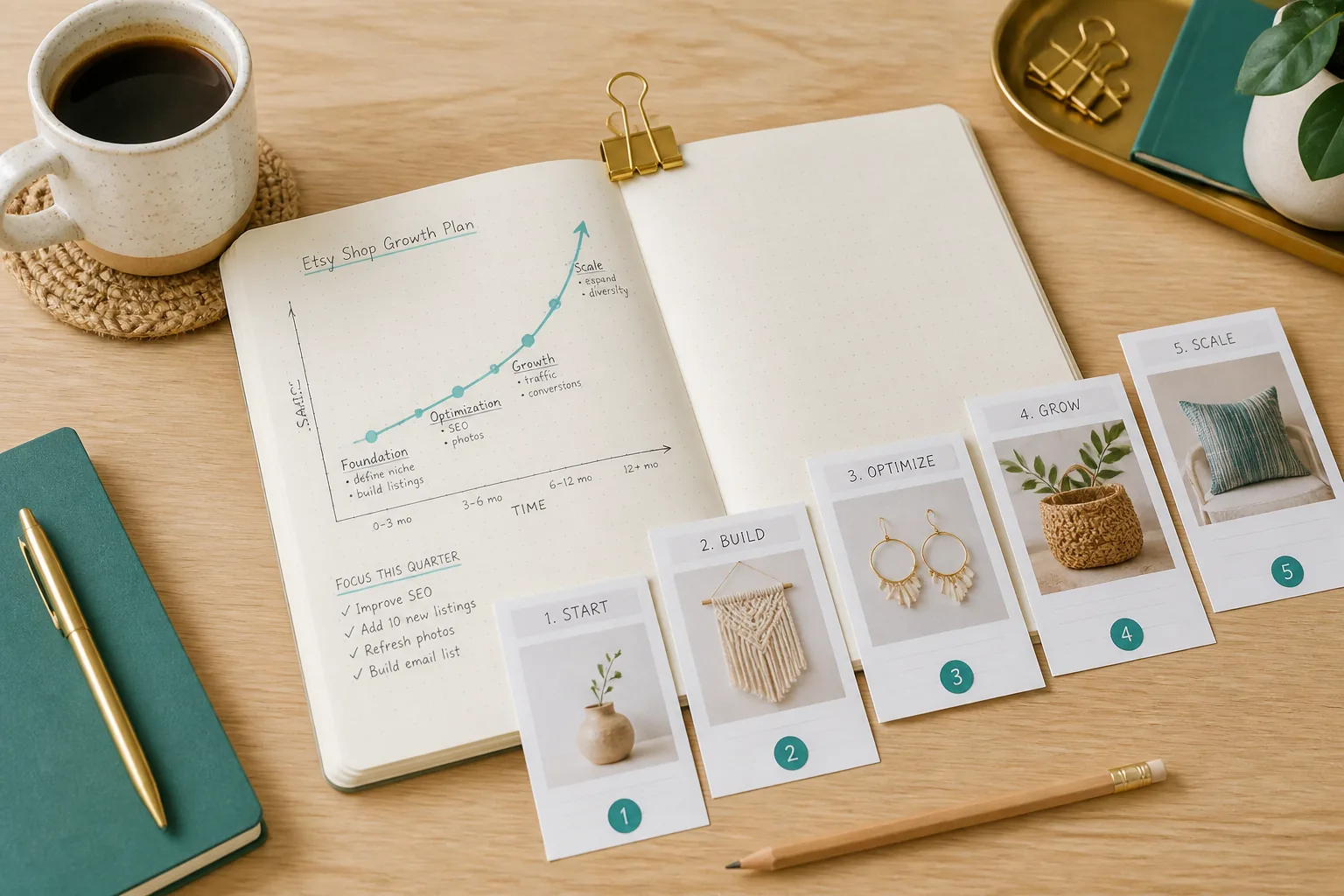
Listing count is the single most argued-about number in any Etsy seller forum. One camp says “quality over quantity, ten perfect listings is enough.” The other says “list a thousand things and let the algorithm sort it out.” Both are wrong because both ignore the actual shape of the curve.
The relationship between how many listings you have and how much you sell is real. It is also not a straight line. Understanding its shape tells you exactly where to put your effort at each stage, and stops you from quitting at listing 25 when you were three weeks from the part that works.
The Listing-Count-to-Sales Relationship Is a Curve, Not a Line
If listings and sales were linear, the math would be simple: ten listings make X dollars, so a hundred listings make ten times X. Nobody’s shop works that way, and assuming it does leads to two opposite mistakes: quitting too early because ten listings made almost nothing, or grinding to a thousand listings expecting proportional returns that never arrive.
The real curve is closer to an S. The early portion is nearly flat: your first handful of listings produce very little, because the algorithm has no idea what your shop is or who to show it to. Then the curve steepens sharply somewhere between 30 and 150 listings, as you accumulate enough search entries and enough algorithmic trust to start getting consistent impressions. Finally it flattens again past a few hundred listings, where each additional listing adds a smaller slice of incremental traffic.
Two things drive the compounding in the steep middle section. First, search surface area: every listing is indexed for its own set of keywords, so each one is a separate doorway into your shop. Second, shop-level trust: Etsy rewards active, coherent shops with more impressions across the board, so a healthy listing count lifts your existing listings too, not just the new ones.
That second effect is why the curve compounds rather than just adds. A new listing doesn’t only earn its own traffic. It strengthens the signal for the whole shop.
Each New Listing Is a Lottery Ticket in Search
Here is the most useful mental model for listing count: every listing you publish is a lottery ticket in Etsy search.
Most listings will never become hits. They’ll get a trickle of impressions, a few clicks, and the occasional sale. That’s normal and expected. But a small fraction of your listings will land on a keyword combination with real demand and weak competition, and those become disproportionate earners: the listings that quietly carry your shop.
You cannot reliably predict in advance which listing wins the lottery. Sellers are wrong about this constantly: the design you were sure would sell sits dead, and the one you almost didn’t publish becomes your top earner. The keyword landscape, seasonal timing, and competition are too complex to call from your desk.
This is exactly why volume matters. If you only hold ten tickets, your odds of holding a winner are low. If none of your ten win, you have no data to learn from and you conclude Etsy “doesn’t work.” With a hundred tickets, you’re almost guaranteed several winners, and just as importantly, you can see which ones won and why. The winners tell you which sub-niches, styles, and keywords to lean into next.
Volume isn’t about flooding Etsy with mediocre work. It’s about buying enough chances to find the signal hiding in the noise.
The Four Stages of Shop Size
Stage 1: 0 to 30 Listings: Teaching the Algorithm
This is the stage where most shops die, because it’s the stage where the math is least rewarding. With fewer than 30 listings, Etsy genuinely doesn’t understand your shop. It can’t tell whether you sell minimalist line art or maximalist botanical prints, so it can’t confidently match you to searchers.
Don’t judge anything here. Your job in this stage is to give Etsy a clear, coherent signal: a tight cluster of listings in one niche so the algorithm can categorize you. Sales will be sparse and that is not a verdict on your shop. It’s the cost of onboarding into search.
Realistic timeline by hand: weeks to a couple of months. The bottleneck is purely production.
Stage 2: 30 to 100 Listings: Building Search Presence
Now you’re on the steepening part of the curve. With 30+ listings, you start appearing for a meaningful spread of keywords. This is where your first consistent sales appear and where your first lottery winners reveal themselves.
The strategic move here is to read the early winners and expand toward them. If your celestial prints outperform your florals three to one, that’s your shop telling you where the demand is. Keep building breadth so the algorithm keeps learning, but bias new listings toward what’s already working.
Realistic timeline by hand: a few months of steady listing. This is where the production bottleneck hurts most: you need volume right when manual creation is slowest.
Stage 3: 100 to 300 Listings: Consistent Daily Sales
Past 100 listings, most shops cross into daily-sales territory. You have enough search surface area that something sells most days even without you touching the shop. The compounding from shop-level trust is now working in your favor: your whole catalog gets more impressions because you’re an established, active shop.
This is the stage where the business starts to feel like a business rather than an experiment. The work shifts from “will this work” to “which clusters do I expand.”
Realistic timeline by hand: many months to over a year. With batch production, a single quarter.
Stage 4: 300+ Listings: Momentum and Diminishing Returns
Past 300, you have real momentum, but the curve flattens. Each new listing now adds less incremental traffic than it did at stage 2, because you’ve already captured most of the obvious keyword territory in your niche.
That doesn’t mean stop. The smart move shifts. At this stage, refining and renewing your proven winners, expanding into adjacent niches, and improving conversion on existing traffic often beats simply adding more raw listings. Volume got you here; optimization carries you further.
Why Digital Products Change the Math Entirely
Everything above applies to physical sellers too, but they face a brutal constraint: every new listing can mean inventory, materials, storage, and fulfillment risk. A physical seller pushing toward 300 listings is taking on real cost and real downside if a listing flops.
For digital products, that constraint largely disappears. A wall art print, a clipart bundle, or an SVG has no per-unit cost, no inventory, no storage, and no fulfillment beyond an automatic download. A listing that never sells costs you nothing but the minutes it took to create.
This completely rewrites the quantity question. When each lottery ticket is nearly free to hold, the optimal number of tickets is much higher. The only real cost of volume for a digital seller is production time, which is precisely the bottleneck batch generation removes.
This is where Elistit’s batch advantage does its work. Producing artwork, mockups, 300 DPI print-ready files, and SEO listing copy for a single product takes under 15 minutes from a one-sentence brief. Run that as a batch and a seller can produce 100 listings in the time a manual workflow produces five. The stage that kills most shops, grinding through the flat early portion of the curve, collapses from months into days. You get to the steep, rewarding middle of the curve before you’ve lost momentum.
For a deeper walkthrough of getting found once you have the volume, see our guide to Etsy SEO. To speed up the publishing side specifically, see publishing Etsy listings faster. And if you’re scaling a printables catalog, the growing printables shops playbook covers the operational side of getting from one stage to the next.
The honest answer to “how many listings should I have” is: more than you currently do, until you reach a few hundred. The constraint on getting there is how fast you can produce, not how many the algorithm will tolerate.
Quick questions
Quickly answered.
Q.01How many listings should a new Etsy shop have?
Aim for 30 listings before you judge anything. Below 30, the algorithm has almost no signal to work with. It doesn't know what your shop is about or which buyers to show it to. Thirty focused listings in one niche gives Etsy enough data to start placing you in search and tells you which directions are worth pursuing.
Q.02Is there an ideal number of Etsy listings?
There's no single magic number, but the useful thresholds are 30 (algorithm learns your niche), 100 (consistent search presence), and 300 (steady daily sales). For digital products with no inventory cost, more listings almost always help up to a few hundred. After that each new listing adds less, and refining winners beats raw volume.
Q.03Does having more listings actually increase Etsy sales?
Yes, but not linearly. Each listing is a separate entry in search for different keywords, so more listings means more chances to be found. The effect compounds early (going from 20 to 100 listings can multiply visibility several times over) then flattens. Volume buys you reach and data; quality decides which of those listings convert.
Q.04Should I focus on quality or quantity of Etsy listings?
Both, in that order of dependency. You need quality listings to convert traffic, but you need volume to learn which designs and keywords are quality. Each listing is a cheap test. The sellers who win treat volume as a way to discover winners, then pour quality attention into the listings that prove themselves.
Q.05How long does it take to build up to 300 Etsy listings?
By hand, a 300-listing shop is roughly 300 to 600 hours of production, typically a year or more part-time. With batch generation, the production bottleneck collapses: producing artwork, mockups, print files, and listing copy for 100 listings can take a few days of focused work instead of months, which is what makes 300 realistic inside a single quarter.
Keep going.
Etsy Batch Upload Strategy: How to List Products Faster Without Sacrificing SEO
An Etsy batch upload strategy that beats one-at-a-time listing: how to batch production and uploads while keeping every listing properly optimized.
How to Create and Sell Clipart Bundles on Etsy
How to create cohesive, profitable Etsy clipart bundles: sizing, themes, file organization, pricing, and the workflow that keeps sets consistent.
How to Create Clipart Bundles with AI
Describe a theme, generate 10 to 25 cohesive images, and get a complete Etsy clipart bundle with a draft listing to review.
How to Sell Digital Downloads on Etsy: Beginner's Guide
Everything you need to start selling digital downloads on Etsy: setting up your shop, creating products, and writing listings that convert.