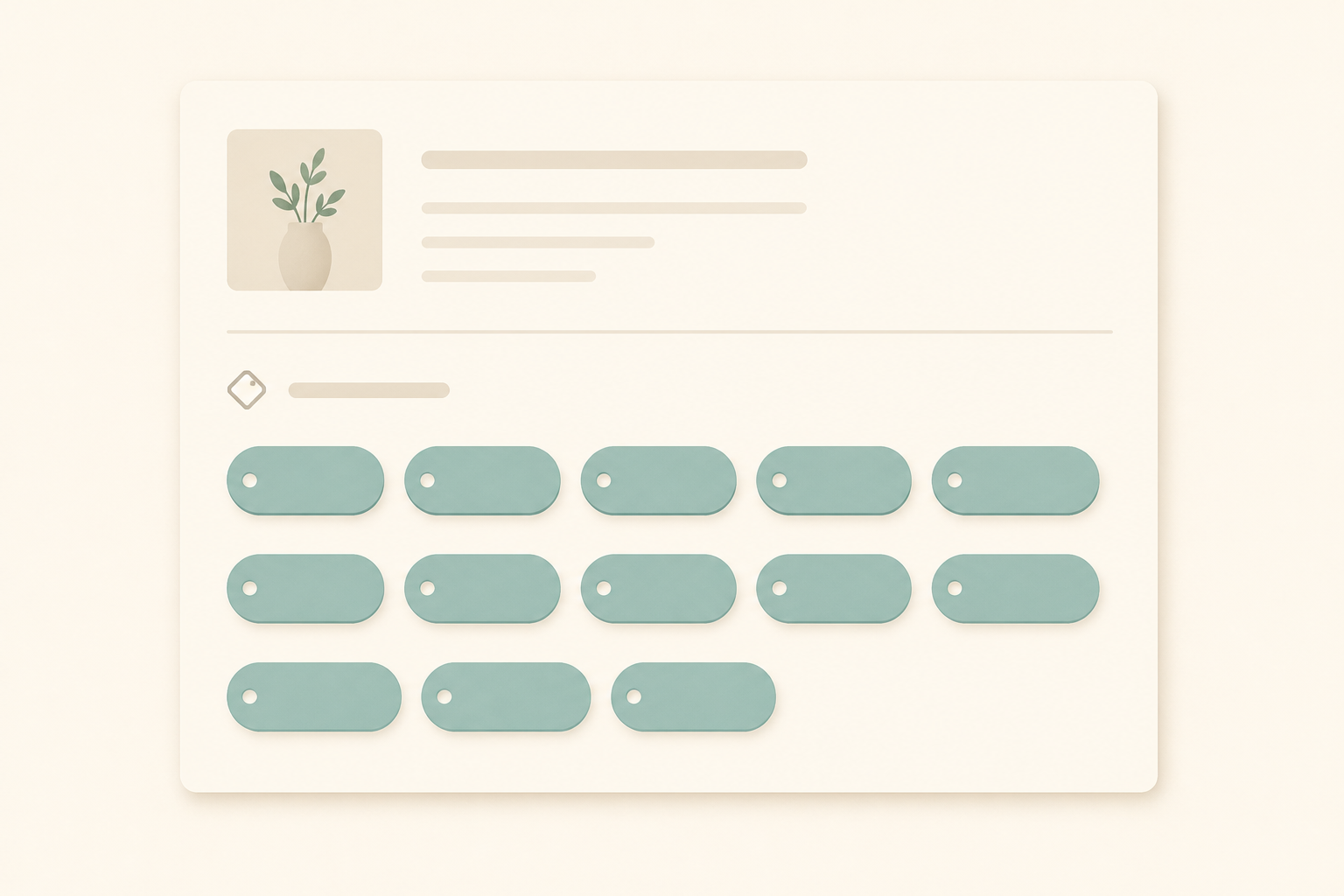
The short answer: 13. Etsy gives every listing 13 tag slots and the algorithm rewards listings that use all of them. Listings with fewer than 13 tags rank worse on identical content. This is one of the easiest 1% improvements you can make across an entire shop.
The longer answer is what to put in those 13 tags, because tag count without tag quality is just filler. This is the strategy that actually moves a listing up the search rankings.
Why 13, not 7 or 10
Etsy’s search algorithm scores a listing on three things in roughly this order: relevance, conversion rate, and listing quality. Tags drive the relevance score. Each tag is an opportunity to match a buyer’s search phrase. Skipping tags means skipping matches.
You can think of it as a coverage problem: every tag is a fishing line in the water. 13 lines catch more buyers than 7. There is no penalty for using all 13, only an opportunity cost for not using them.
Tag-by-tag strategy: the 13-slot framework
Allocate the 13 slots across categories of buyer intent. This is the framework that performs best on wall art, clipart, posters, and stickers; adjust the proportions for other niches.
| Slot | Type | Example (for a watercolor floral wall art listing) |
|---|---|---|
| 1–3 | Exact-match primary phrases (long-tail) | “watercolor floral print”, “boho wall art print”, “neutral wall decor” |
| 4–6 | Buyer-intent + product type | ”printable wall art”, “digital download print”, “instant download art” |
| 7–9 | Style / aesthetic descriptors | ”minimalist home decor”, “modern farmhouse art”, “soft pastel print” |
| 10–11 | Use case / room | ”living room art”, “nursery wall decor” |
| 12 | Gift occasion (if relevant) | “housewarming gift” |
| 13 | Trending / seasonal | ”spring 2026 decor” (rotate quarterly) |
This framework gives you coverage across the four ways Etsy buyers actually search:
- By what it is (slots 1–3 + 4–6)
- By how it looks (slots 7–9)
- By where it goes (slots 10–11)
- By why they’re buying (slots 12–13)
A listing tagged across all four buckets shows up for far more searches than one tagged only on the “what it is” axis.
Long-tail beats short-tail
Short tags like “art” or “print” or “wall decor” are too competitive; your listing is buried under millions. Long-tail tags (“boho watercolor floral print”) have less competition and higher buyer intent. The buyer who types four-word searches knows what they want and converts at much higher rates.
The rule of thumb: aim for tags between 2 and 4 words. Single-word tags (“art”) are almost always wasted slots.
Exact-match the title where you can
The single highest-impact pairing on Etsy is a tag that exactly matches a phrase in your listing title. The algorithm reads this as a strong relevance signal.
If your title is “Boho Watercolor Floral Print | Neutral Wall Decor | Living Room Art”, your tags should include exactly those phrases as standalone tags wherever they fit in 20 characters or less.
Don’t repeat the same exact phrase twice in tags. Etsy explicitly recommends against it. But pulling phrases from the title into tags is fine and helps.
Tags vs categories vs attributes
Tags are not the only relevance signal. Etsy also reads:
- Category: the taxonomy you placed the listing in (e.g., Art & Collectibles → Prints → Digital Prints)
- Attributes: the structured fields you fill in (color, size, occasion, holiday)
- Title: every word in the listing title
Tags carry the most weight per slot, but a perfect tag stack doesn’t fix a wrong category or empty attributes. Fill all of them. Together they form your relevance footprint.
What not to put in tags
- Single words: wasted slots
- Plural forms of words already in singular: Etsy treats them equivalently, so “print” and “prints” don’t both need their own tag
- Misspellings: Etsy auto-corrects buyer searches, so misspellings don’t earn extra traffic
- Tag stuffing (“art print wall decor home gift”): the algorithm reads natural-language phrases, not keyword soup
- Trademarked names: Disney, Marvel, Nike and similar will get the listing taken down
Refresh tags every 60 days
Tag performance shifts. A “spring 2026 decor” tag dies on June 21 and becomes a wasted slot. Every 60 days, audit your low-performing listings:
- Open Etsy Stats → Listings → sort by views (low to high)
- For each underperformer, replace 2–3 tags with new long-tail variants
- Wait 14 days, measure again
The shops that grow consistently treat tags as a living system, not a one-time setup.
How Elistit handles tag generation
Every listing produced through Elistit ships with 13 SEO-optimized tags drafted for review, covering all four intent buckets above. Tags are pulled from your title, your style preferences, the niche your shop is positioned in, and (where relevant) seasonal/trending data from the market intelligence layer.
You see all 13 tags before the listing draft is finalized. Edit, swap, or replace any of them. The defaults are calibrated to the framework in this article. You don’t have to think about it unless you want to.
See how SEO listing copy is generated →
FAQ
Does using fewer tags hurt my listing? Yes. Listings with 13 tags consistently outperform listings with 7–10 tags on otherwise identical content. There’s no scenario where skipping tag slots helps.
Can I use the same tag on multiple listings? Yes, and you should, when it’s genuinely relevant. Etsy doesn’t penalize repetition across listings. Cross-listing tag overlap signals shop coherence.
Should tag order matter? Etsy says no. In practice, the safe assumption is that order is irrelevant. Worry about tag quality, not slot order.
How do I find new long-tail tags? Type your seed phrase into Etsy search and look at the autocomplete suggestions. Those are real buyer queries. Add the ones that match your listing.
Are 20-character tags better than shorter ones? Up to a point. Tags can be up to 20 characters and Etsy lets multi-word tags rank for any of their constituent words. So “boho watercolor print” (20 chars) ranks for “boho”, “watercolor”, “print”, and the phrase itself. That’s better than three single-word tags.
Quick questions
Quickly answered.
Q.01Does using fewer tags hurt my listing?
Yes. Listings with 13 tags consistently outperform listings with 7-10 tags on otherwise identical content. There's no scenario where skipping tag slots helps.
Q.02Can I use the same tag on multiple listings?
Yes, and you should, when it's genuinely relevant. Etsy doesn't penalize repetition across listings. Cross-listing tag overlap signals shop coherence.
Q.03Should tag order matter?
Etsy says no. In practice, the safe assumption is that order is irrelevant. Worry about tag quality, not slot order.
Q.04How do I find new long-tail tags?
Type your seed phrase into Etsy search and look at the autocomplete suggestions. Those are real buyer queries. Add the ones that match your listing.
Q.05Are 20-character tags better than shorter ones?
Up to a point. Tags can be up to 20 characters and Etsy lets multi-word tags rank for any of their constituent words. So 'boho watercolor print' (20 chars) ranks for 'boho', 'watercolor', 'print', and the phrase itself. Better than three single-word tags.
Keep going.
Best Digital Art Sizes for Etsy in 2026
The exact dimensions, ratios and DPI Etsy buyers expect for digital wall art and posters in 2026, with frame mappings, format guidance, and the maths.
Etsy SEO Checklist for Printable Sellers (2026)
An 18-point Etsy SEO checklist for printable shops: title, tags, attributes, photos, and the listing-quality signals that move rankings.
Etsy Wall Art Sizes 2026: The Complete Print-Ratio Guide
Every standard wall art ratio Etsy buyers print at home, with pixel dimensions at 300 DPI and the frame sizes each ratio fits.
Etsy Competitiveness & Search Volume: Reading the Signals Before You List
An Etsy competitiveness score reads how contested and searched a keyword is. How to interpret the signals and pick keywords you can actually rank for.